50th Anniversary Special: first photo released

Monday, 1 April 2013 - Reported by Chuck Foster
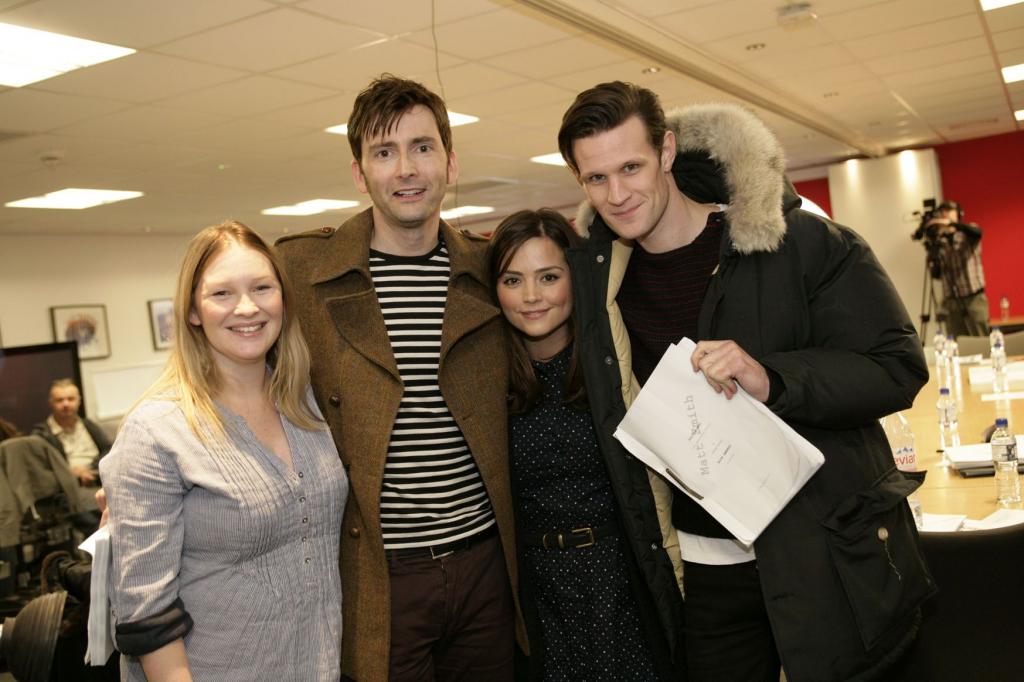
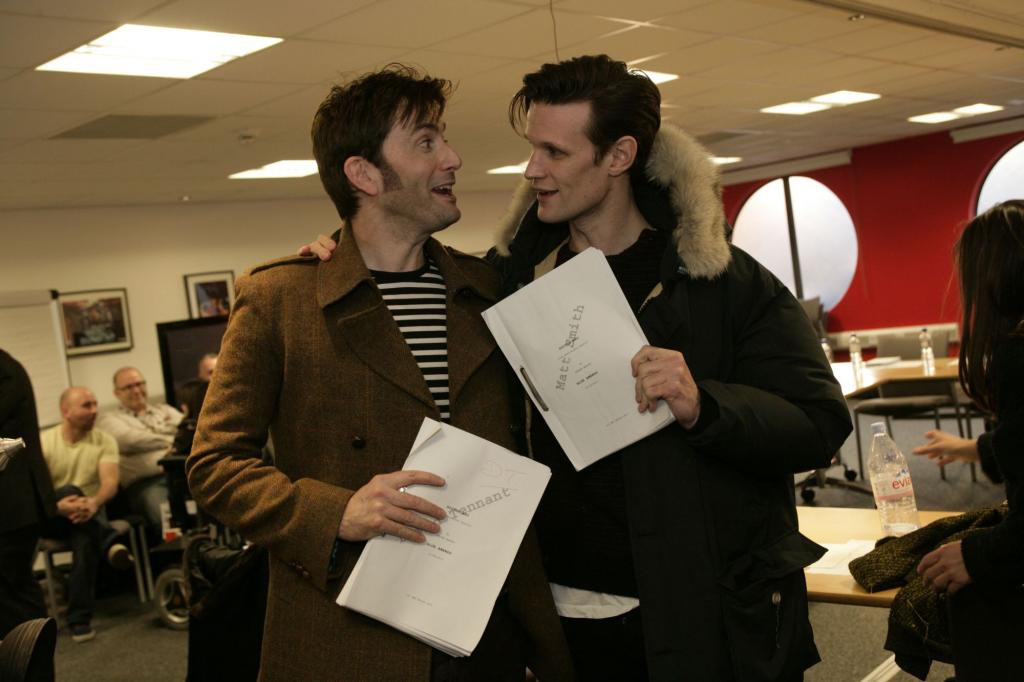
The BBC have released the first publicity photo for the 50th Anniversary Special, featuring Matt Smith and David Tennant together at the episode read-through that took place today:

Matt Smith and David together at the 50th Anniversary Special readthrough (Credit: BBC)

Filming for the special takes place over the next few weeks.


FILTER: - Day of the Doctor - Matt Smith - David Tennant - Press

The Bells of Saint John: AI 87

Monday, 1 April 2013 - Reported by Marcus

The Bells of Saint John had an Appreciation Index, or AI score, of 87.

The Appreciation Index or AI is a measure of how much the audience enjoyed the programme. The score, out of a hundred, is compiled by a specially selected panel of around 5,000 people who go online and rate and comment on programmes.

Doctor Who scored higher than most of Saturday's output. Other high scoring programmes were Casulty with 87, Richard Briers: A Tribute with 88 and Easter From Kings with 89.


FILTER: - Doctor Who - Ratings - Series 7/33

The Bells of Saint John - 6.2 million Overnight Viewing Figure

Sunday, 31 March 2013 - Reported by Marcus
The Bells of Saint John had an overnight audience of 6.18 million viewers, a share of 29.8% of the total TV audience.

Doctor Who was the third most-watched programme of the day, which saw old rivals Ant and Dec take the top slot with their Saturday Night Takeaway, getting 7.19 million watching. The Voice UK, which was up against Ant and Dec, came second with fractionally more viewers than Doctor Who with 6.24 million.

Doctor Who won the time slot with You've Been Framed! on ITV getting 3.6 million watching.

Overall Doctor Who currently stands at the 22nd most watched programme of the week. Final ratings will be released next week, which, if recent trends are followed, should see Doctor Who substantially increase its rating once those who timeshift the programme are factored in.


FILTER: - Doctor Who - Ratings - Series 7/33

David Tennant And John Hurt to star in 50th Anniversary

Saturday, 30 March 2013 - Reported by Marcus
The BBC have now confirmed that the Tenth Doctor David Tennant will star in the 50th Anniversary episode of Doctor Who.

The news leaked earlier today thanks to a mistake in the distribution of Doctor Who Magazine, which saw subscribers receive their issues 5 days early, forcing the BBC to issue a hurried press release. Tennant will join current stars Matt Smith and Jenna-Louise Coleman in the special episode.

Also joining the cast will be the Ninth and Tenth Doctor's companion Billie Piper.

Tennant played The Doctor from 2005-2010, appearing in 47 episodes of the series, while Piper played Rose Tyler for the 2005 and 2006 seasons, along with cameos in later episodes.

DWM also reports that international film star John Hurt will join the cast for the special episode, which begins filming next week.

John Hurt is one of the UK's most respected actors appearing in films such as The Elephant Man, where he played John Merrick, Nineteen Eighty-Four where he played Winston Smith and Scandal where he played Stephen Ward. On Television he is best known for playing Caligula in the renowned I, Claudius and Quentin Crisp in The Naked Civil Servant. His distinctive voice has been used in many productions such as Watership Down and the animated The Lord of the Rings.

He has received two Academy Award nominations, a Golden Globe Award, and four BAFTA Awards.

It is expected that the special episode will be transmitted on Saturday 23rd November, 50 years to the day since the launch of Doctor Who.


FILTER: - Day of the Doctor - Billie Piper - David Tennant

Doctor Who Spoilers

Saturday, 30 March 2013 - Reported by Marcus
Major news about the casting for the 50th Anniversary special has been leaked, thanks to a mistake in the distribution of Doctor Who Magazine.

The official magazine is due to be published next Thursday, but many subscribers have received their copy today complete with news on the casting of the anniversary episode, due to be shown on the programme's 50th Anniversary next November.

Doctor Who Magazine and the BBC have asked us not to publish details of the casting until the news is officially released next week.


FILTER: - Doctor Who - Day of the Doctor - DWM

Doctor Who wins Institutional Peabody Award

Friday, 29 March 2013 - Reported by Chuck Foster
The winners of the 72nd Annual Peabody Awards were announced this week, with Doctor Who winning an Institutional Peabody. The presiding committee said:
Peabody AwardsSeemingly immortal, 50-years-old and still running, this engaging, imaginative sci-fi/fantasy series is awarded an Institutional Peabody for evolving with technology and the times like nothing else in the known television universe.
 

The George Foster Peabody Awards were first presented in 1941, and is administered by the Grady College of Journalism and Mass Communication at the University of Georgia. Nominations are considered by a panel of academics, critics, industry practitioners and experts within culture and the arts, who look to award "excellence on its own terms". As its aim is to reflect excellence in quality rather than popularity or commercial success, the Peabody is considered by many to be the industry’s most competitive honour.

Olivier Award Nominations

The nominations for the 2013 Olivier Awards have been announced, and include a few names related to Doctor Who, with Billie Piper nominated as Best Actress for her role as Connie in The Effect, Adrian Scarborough (who previously won in 2011) nominated for Best Actor in a Supporting Role for Hedda Gabler, Imelda Staunton nominated as Best Actress in a Musical for Mrs Lovett in Sweeney Todd, and Helen McCrory nominated as Best Actress in a Supporting Role for The Last of the Haussmans.

The Awards Ceremony takes place at the Royal Opera House on 28th April, and will be hosted by Sheridan Smith and Hugh Bonneville.


FILTER: - Doctor Who - Awards/Nominations

BFI Brings In Ticket Ballot For Anniversary Screenings

Friday, 29 March 2013 - Reported by John Bowman
Overwhelming demand for events in the BFI's Doctor Who At 50 celebratory season has led to a rethink on ticket allocation.

As part of the season, the organisation is showing one story per Doctor per month with an accompanying guest panel, and all events so far have sold out to members - who get priority booking - immediately after being made available to them, which has led to huge numbers of fans who are not members missing out and being left disappointed.

As a result, the BFI is introducing a ticket ballot system for May's screening onwards. The Caves of Androzani, which marked the end of the Fifth Doctor's era, is being shown on Saturday 4th May at 2pm, and seats are being restricted to two per buyer, with a ballot also being run to try to ensure the fairest possible allocation.
 
BFI Champions can apply from Monday 1st April and BFI Members from Tuesday 2nd April. They will be able to apply via e-mail up to 8.30pm on Friday 5th April saying how many seats they would like, but will only be allowed a maximum of two. These will then be allocated by ballot, and not on a first-come first-served basis.

Ticket applicants can ask for specific seat numbers in their e-mail and the BFI says it will do its best to meet those requests. If applicants are happy to sit elsewhere in the auditorium if their choice is unavailable they should state this in their application and the BFI will try to seat them as near as possible to where they wanted to be. If people only want their specified seats or are happy to be seated anywhere in the auditorium they are similarly asked to state this in their application.

Any tickets that are left over following the ballot plus about 25 set aside for the public will then go on release to non-members on Tuesday 9th April when, again, purchasers will be restricted to two seats each.

As in the past, returns and stand-bys are also always a possibility once an event has sold out, so keep checking back with the BFI.


FILTER: - Special Events - BFI - WHO50 - Fifth Doctor

Silva Screen: The Krotons

Thursday, 28 March 2013 - Reported by Chuck Foster
The second in the range of classic Doctor Who soundtracks has been announced by Silva Screen Records, this time focussing on the Second Doctor with the electronic soundscape created by Brian Hodgson for The Krotons.

The Krotons (soundtrack) (Credit: Silva Screen)Originally transmitted in 4 episodes on BBC1 between 28th December 1968 and 18th January 1969, The Krotons starred Patrick Troughton as the second Doctor. The soundtrack (or "special sounds") were created by Brian Hodgson and the BBC Radiophonic Workshop, who said:
For this story I mainly used the “Crystal Palace”, so called because its case was made of clear Perspex which exposed its workings. This machine, created by our engineer Dave Young, could mechanically sample 16 inputs and combine them into a single output in 4 prearranged patterns. The progression of the patterns was deliberately slow to create textures of sound. I was very much interested in exploring changing aural textures in tracks such as “The Learning Hall” and “Kroton Theme”.

Generating and manipulating music and sound effects defines sound design, a process that is common on TV and film productions nowadays. However The BBC Radiophonic Workshop was way ahead of the game in the 1960s. Brian Hodgson was a member of the Workshop working closely with the seminal figure of Delia Derbyshire. As the original sound effects creator for Doctor Who he was responsible for the chilling Dalek voices and the powerhouse sound of the Tardis lifting off (created by running a back door key for his mother's house along the bass string of a gutted piano and treating it electronically). His highly innovative techniques are fully on display on this collection of 'special sounds' that provided the background to Doctor Who - The Krotons.
 
  1. Doctor Who (New Opening Theme, 1967)
  2. The Learning Hall
  3. Door Opens
  4. Entry Into The Machine
  5. TARDIS (New Landing)
  6. Wasteland Atmosphere
  7. Machine And City Theme
  8. Machine Exterior
  9. Panels Open
  10. Dispersal Unit
  11. Sting
  12. Selris' House
  13. Machine Interior
  14. Snake Bleeps Low
  15. Silver Hose (The Snake)
  16. Snake Bleeps High
  17. Teaching Machine Hums
  18. Forcefield
  19. Burning Light
  20. Birth Of A Kroton
  21. Kroton Theme
  22. Kroton Dies
  23. Link – Rising Hum
  24. Kroton Dies – (Alternative)

The soundtrack is due to be released on the 13th May 2013 on CD and download, and will also be released as a limited edition 10" Vinyl disc on the 24th May.

Competition

Thanks to Silva Screen we have three copies of the CD for our readers to win. To be in with a chance, simply answer this question:

Brian Hodgson is one of the original participants in the creation of Doctor Who back in 1963, and will be featured in the forthcoming Mark Gatiss drama An Adventure in Space and Time - but which actor will portray him?

Please send your answer to krotons-competition@doctorwhonews.net with the subject line "Winner-Gond!", along with your name, address, and where you read about this competition. The competition is open worldwide, and the closing date will be on the 30th April 2013. Only one entry per household will be accepted.


There is still time to enter our The Caves of Androzani soundtrack competition - see here for more details (closing date 31st March).


FILTER: - Merchandise - Audio - Second Doctor - Competitions - Classic Series - WHO50

Doctor Who Revisited: The Third Doctor

Wednesday, 27 March 2013 - Reported by Chuck Foster
BBC America will broadcast the next in their Doctor Who Revisited series on the 31st March, covering the Third Doctor's era.

BBC AMERICA celebrates the third Doctor, Jon Pertwee, in a new special of Doctor Who: The Doctors Revisited. Lead writer and executive producer Steven Moffat, executive producer Caroline Skinner, Tenth Doctor David Tennant, Season Six guest star Hugh Bonneville (Downton Abbey), among others, discuss how the third Doctor brought action and stunts to the series.

It is followed by the classic storyline Spearhead from Space. In the story, a swarm of meteorites fall on the sleepy English countryside, bringing with them a terrible new threat to mankind: the Nestene consciousness - a disembodied alien intelligence with an affinity for plastic. The Doctor is forced to race against time, in order to stop humanity from being replaced by a generation of terrifying plastic replicas.


Doctor Who: The Doctors Revisited – The Third Doctor premieres Sunday, March 31, 8:00pm ET/PT.


FILTER: - Steven Moffat - USA - BBC America - Third Doctor - David Tennant - Caroline Skinner

An Unearthly Series: The Origins of a TV Legend

Tuesday, 26 March 2013 - Reported by John Bowman
A Meeting of Great Minds
The eighth in our series of features looking at events leading to the creation of a true TV legend.

The story so far: Sydney Newman, the new Head of Television Drama at the BBC has asked the Script Department to come up with ideas for a new science-fiction series that would not not only bridge the gap on Saturday evenings between Grandstand and the pop music show Juke Box Jury but also appeal to both audiences.

It was on 26th March 1963 - exactly 50 years ago today - that four people convened in an office in Television Centre to lay down the ground rules for the series that would develop, eight months later, into Doctor Who.

Donald Wilson chaired the meeting in his role as Head of the Script Department, and it took as its starting point the reports on science-fiction compiled the previous year by the Survey Group, whose authors, John Braybon and Alice Frick, were present. They were joined by a fourth member of the script department, Cecil Edwin Webber.

Better known by the nickname "Bunny", Cecil Webber was an established playwright with credits on the stage and screen. His published stage plays had included Be Good, Sweet Maid in 1957 and Out of the Frying Pan in 1960, while for television he had written the 1961 action-adventure serial Hurricane and in 1962 the children's comedy William, which starred Dennis Waterman in one of his earliest roles and was adapted from some of the Just William books by Richmal Crompton.

The meeting set out to lay down some ground rules for the series, with discussions ranging from the practical to the esoteric and with concepts such as the nature of energy and the persistence of human thought being debated. Many ideas were put forward, with all agreeing that around seven or eight ideas would be needed to make enough stories to fill a 52-week series.

Some discussion was held over the type of craft to be used in the series. As detailed in a subsequent report by Frick, Wilson thought that if a time machine was used it should be able to travel not only backwards and forwards in time but also into all kinds of matter such as a drop of oil or under the sea. Meanwhile, Frick thought it might be more modern to feature a flying saucer carrying the regular cast of characters from story to story. Wilson was anxious to avoid the use of a computer as this was the main plot device in the BBC's Andromeda TV series of 1961 and 1962. Braybon wanted the series set in the future and suggested it featured a set of scientific trouble-shooters. It was also thought that the series should feature telepathy as a good plot device.

Wilson was keen that the series should feature a regular cast of characters. He felt this was important to build audience loyalty and said that two young teenagers should be included in the team, given the time slot the series would be aimed at. Frick felt that children of school age were more interested in characters older than themselves and suggested someone in their early-20s, something with which Webber and Braybon agreed.

The meeting ended with Frick tasked with making a report and Webber commissioned to write up a list of viable characters for the series, based on the discussion, and an outline set-up.

The concept Webber came up with and documented in a memo just three days later was for a series set around "The Troubleshooters", a group of three scientists who tackle problems that no-one else could handle. The drama would have three main characters to lead viewers through a series of stories each running for around 7 weeks. Although the series finally produced would be very different in style and concept to this first draft, the genesis of the character of The Doctor can clearly be seen in the outline for the Troubleshooters and in particular in the character of the third lead.

Memo from C.E. Webber to Donald Wilson. 29th March 1963

Concept notesConcept notes
Characters and Setup

Envisaged is a "loyalty programme", lasting at least 52 weeks, consisting of various dramatised S.F. stories, linked to form a continuous serial, using basically a few characters who continue through all the stories. Thus if each story were to run six or seven episodes there would be about eight stories needed to form fifty-two weeks of the overall serial.

Our basic setup with its loyalty characters must fulfil two conditions:-
  1. It must attract and hold the audience.
  2. It must be adaptable to any S.F. story, so that we do not have to reject stories because they fail to fit into our setup.
Suitable characters for the five o'clock Saturday audience.

Child characters do not command the interest of children older than themselves. Young heroines do not command the interest of boys. Young heroes do command the interest of girls. Therefore, the highest coverage amongst children and teenagers is got by:-

THE HANDSOME YOUNG MAN HERO (First character)
A young heroine does not command the full interest of older women; our young hero has already got the boys and girls; therefore we can consider the older woman by providing:-

THE HANDSOME WELLDRESSED HEROINE AGED ABOUT 30 (Second character)
Men are believed to form an important part of the 5 o'clock Saturday (post-Grandstand) audience. They will be interested in the young hero; and to catch them firmly we should add:-

THE MATURER MAN, 35 - 40, WITH SOME "CHARACTER" TWIST. (Third character)
Nowadays, to satisfy grown women, father-figures are introduced into loyalty programmes at such a rate that TV begins to look like an Old People's Home: let us introduce them ad hoc, as our stories call for them. We shall have no child protoganists [sic], but child characters may be introduced ad hoc, because story requires it, not to interest children.

What are our three chosen characters?

The essence of S.F. is that the wonder or fairytale element shall be given a scientific or technical explanation. To do this there must be at least one character capable of giving the explanation, and I think that however we set up our serial, we must come around to at least one scientist as a basic character. I am now suggesting that all three be Scientists, though handsome and attractively normal people. Such vague cliches as Government Project, Secret Research, Industrial Atomics, Privately Financed Laboratory in Scotland, do not necessarily involve our group in every kind of S.F. story presented to us. Therefore I suggest that they are, all three,

THE PARTNERS IN A FIRM OF SCIENTIFIC CONSULTANTS.
They are a kind of firm which does not exist at present, being an extension of today's industrial consultant into the scientific era. We are in a time which is not specified but which is felt to be just a bit ahead of the present; but the wonder is introduced into today's environment. The firm carry on normal lines of research in their own small laboratory, or in larger ones elsewhere if the job requires it; this is their bread and butter; but they are always willing to break off to follow some more unusual case. In fact, they have a reputation for tackling problems which no-one else could handle; there is almost a feeling of Sherlock Holmes about this side of their work. Our stories are the more unusual cases which come their way. This setup gives us fluidity for an everlasting serial. One, or two, of them can persue [sic] a story, leaving at least one behind to start on the next case when we need to transfer to another story. They are:-

"THE TROUBLESHOOTERS"
Each of them is a specialist in certain fields, so that each can bring a different approach to any problem. But they are all acutely conscious of the social and human implications of any case, and if the two men sometimes become pure scientist and forget, the woman always reminds them that, finally, they are dealing with human beings. Their Headquarters or Base illustrates this dichotomy: it consists of two parts: 1. a small lab fitted with way-out equipment, including some wondrous things acquired in previous investigations and 2. an office for interviews, homely, fusty, comfortable, dustily elegant: it would not have been out of place in Holmes's Baker Street.

Villains.
It would be possible to devise a permanent villain for the above "Troubleshooters" setup. Our heroes find themselves always coming up against him in various cases: the venal politician who seeks to use every situation to increase his own power; or the industrialist always opposing our heroes. Possibly some continuing villain may create himself as we go, but I suggest that we create ad hoc villains for each story, as needed. It is the Western setup in this respect: constant heroes, and a fresh villain each time.

Overall Meaning of the Serial.
We shall have no trouble in finding stories. The postulates of S.F., from which its plots derive, can be broadly classified, even enumerated; and we all have additions or startling variations up our sleeves. But I think we might well consider if there is any necessary difference between the dramatic and the literary form, as regards S.F.
  • a. S.F. deliberately avoids character-in-depth. In S.F. the characters are almost interchangable. We must use fully conceived characters.
  • b. S.F. is deliberately unsexual; women are not really necessary to it. We must add feminine interest as a consequence of creating real characters.
  • c. Because of the above conditions, S.F. does not consider moral conflict. It has one clear overall meaning: that human beings in general are incapable of controlling the forces they set free. But once we have created real characters, we must consider the implications in terms of those characters in their society. Drama is about moral conflicts: it is about social relationships. Experienced S.F. writers may disagree with me. Well, let them create their own live S.F. drama. But for me, it seems a fine opprtunity to write fastmoving, shocking episodes, which necessarily consider, or at least firmly raise, such questions as: What sort of people do we want? What sort of conditions do we desire? What is life? What are we? Can society exist without love, without art, without lies, without sex? Can it afford to continue to exist with politicians? With scientists? And so on.
The final section mirrored the 1962 reports, which had emphasised that TV science-fiction ought to lean more towards being character-based than had been the case in literature, that it would need the addition of "feminine interest", and that philosophical or moral questions needed to be at least firmly raised if not considered.

The day after the meeting - on 27th March 1963 - a memo was sent by John Mair, the senior planning assistant responsible for allocating TV studio time, to Joanna Spicer, the Assistant Controller (Planning) Television, asking her for details about the planned new series.

Webber's memo was attached to Frick's report (as mentioned above), the latter of which read in full as follows:

    The following devices were discussed:
    1. Time Machine: Donald Wilson suggested if this were used, it should be a machine not only for going forward and backwards in time, but into space, and into all kinds of matter (e.g. a drop of oil, a molecule, under the ocean, etc.)
    2. Flying Saucer: Alice Frick thought this might be a more modern vehicle than a time machine, much discussed at present, and with a considerable body of literature concerning it. It would have the advantage of conveying a group of people (i.e. the regular cast of characters).
    3. Computer: Donald Wilson thought this should be avoided, since it was the Andromeda device.
    4. Telepathy: This is an okay notion in modern science, and a good device for dealing with outer-space inhabitants who have appropriated human bodies (e.g. Three To Conquer by Eric Frank Russell).
    5. John Braybon suggested that the series should be set in the future, and that a good device would be a world body of scientific trouble-shooters, established to keep scientific experiments under control for political or humanistic reasons.

    Ideas:
    A good many possible (and probably some impracticable!) ideas for themes and content were discussed, among them some published works - Guardians of Time by Poul Anderson and Three To Conquer by Russell.
    Some recent scientific discoveries or developments whose uses are still not known nor explored were mentioned, e.g. the Laser Beam. We all thought that the use of seven or eight such "new" ideas, one for each short serial, could make a 52-week series.
    Bunny Webber brought forward the idea of the continuance of thought; the idea that great scientists of the past might continue in some form of existence and could be contacted to discover further advances they had made, ideas they might bring to current discoveries, thought, etc.
    Donald Wilson introduced a discussion of human creativity, the presence in the world of the human capacity to initiate original thought, to create new concepts, ideas, etc, the immeasurable and inexplicable work and productivity of genius. This led on to a discussion of energy, the difference between scientific energy, which can be measured, and human energy, which cannot.

    Format:
    Donald Wilson said that the series must be based on a group of regular characters, some of whom would be employed in major roles in one limited serial, others in the next, according to the needs of the different stories. He felt this was essential to establishing a loyalty audience. He suggested that, for the time-slot, two young teenagers should be included. Alice Frick advanced the opinion that children of that age were more interested in characters who are older than themselves, in the early twenties. Braybon and Webber supported this idea. Young children could be introduced occasionally, but should not be among the regulars.
    The major problems in format are, how to involve a part of a permanent group in widely differing adventures, and how to transport them believably to entirely disparate milieux.
The following month would see Newman responding to Webber's memo and Frick's report, pushing the team more towards how he envisaged the series, and his annotations to the memo can be clearly seen.

Next EpisodeJourney into the Unknown
Compiled by:
Marcus and John Bowman
SOURCES: BBC Archive - The Genesis of Doctor Who; The Handbook (Howe, Walker, Stammers; 2005)


FILTER: - The Story of Doctor Who