Friday, 25 January 2013 - Reported by Chuck Foster
The British Film Institute have now made parts of the Q&A panel with guests at the screening of An Unearthly Child on 12th January available to watch via their YouTube channel.
The first, nine minute segment from before the story was shown features a chat with the story's vision mixer Clive Doig and special sounds creator Brian Hodgson, alongside writer/actor Mark Gatiss (writer of the 50th Anniversary drama An Adventure in Space and Time). The second, fifteen minute segment features a cast and crew discussion after the showing, with Waris Hussein (director), William Russell (Ian), Carole Ann Ford (Susan), Jeremy Young (Kal), Donald Tosh (writer/script editor), and William Hartnell's granddaughter Jessica Carney.
Friday, 25 January 2013 - Reported by Chuck Foster
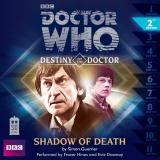
BBC AudioGo have released details for next month's release in their 50th Anniversary special series Destiny of the Doctor. Shadow of Death is written by Simon Guerrier and set during the Second Doctor's era; it is performed by Frazer Hines (Second Doctor companion Jamie McCrimmon), with Evie Dawnay.
Destiny of the Doctor: Shadow of Death Written by Simon Guerrier Starring Frazer Hines, with Evie Dawnay Released 7th February 2013(pre-order)
Following an emergency landing, the TARDIS arrives on a remote world orbiting a peculiar star – a pulsar which exerts an enormous gravitational force, strong enough to warp time.
On further exploration the Doctor and his friends, Jamie and Zoe, discover a human outpost on the planet’s surface, inhabited by scientists who are there to study an ancient city. The city is apparently abandoned, but the scientists are at a loss to explain what happened to its sophisticated alien architects. The Doctor discovers that something dark, silent and deadly is also present on the world – and it is slowly closing in on the human intruders...
Matt Smith is nominated for Drama Performance: Male, for which he is competing against Benedict Cumberbatch (the title role in Sherlock), Colin Morgan (the title role in Merlin), and Daniel Mays (Ronnie Biggs in Mrs Biggs).
Meanwhile, Karen Gillan faces Sheridan Smith (Charmian Biggs in Mrs Biggs), Suranne Jones (Det Con Rachel Bailey in Scott & Bailey), and Miranda Hart (Chummy Browne in Call The Midwife) for the Drama Performance: Female gong.
In other categories, Would I Lie To You?, featuring David Mitchell, is among the nominees for Comedy Panel Show, The Apprentice (with Lord Alan Sugar) and Paul O'Grady: For The Love Of Dogs are included in Factual Entertainment, Absolutely Fabulous (with June Whitfield) and Benidorm (co-written by and co-starring Steve Pemberton) are up for Situation Comedy, Coronation Street (produced by Phil Collinson) is nominated for Serial Drama, and The Chase, hosted by Bradley Walsh, is nominated in the Daytime category.
Both Smith and Gillan won in their respective categories in last year's NTAs, but the show lost out to Downton Abbey as Most Popular Drama.
Votes can be cast via this link and must be confirmed by midday on Wednesday 23rd January, when voting closes. The ceremony - the 18th NTAs - takes place at the O2 Arena in London and will be broadcast live on ITV1 from 7.30pm the same day.
To celebrate 50 years of Doctor Who, John Richards (creator/writer of the ABC1 sitcom Outland, Boxcutters podcast) and Ben McKenzie (Channel 31′s Planet Nerd, Dungeon Crawl, ‘patron saint of geek comedy’ – T-Squat magazine) have joined forces to host a year-long performance/podcast project, entitled "Splendid Chaps", in Melbourne, Australia.
Each month from January to November 2013 John and Ben will record a live Doctor Who panel discussion – one for each of the eleven Doctors – with a different theme, special guests, musical and comedy performances and loveliness. These will also be edited into podcast episodes, released on the 23rd of each month.
The first event on 13 January will discuss the first doctor and features special guest Alexandra Tynan (nee Sandra Reid), the woman who designed the Cybermen back in 1966. She’ll be joined by writer and filmmaker Lee Zachariah (ABC2′s The Bazura Project, Hell Is For Hyphenates podcast); broadcaster and host of 3RRR FM’s LiveWire, Nerida Haycock; announcer Petra Elliot and Ben and John as hosts. The musical guest (singing a Who-related number) will be comedian and cabaret artiste Geraldine Quinn.
The forum will be held on Sunday13 January 2012 at 5pm at the Annexe, Bella Union, Trades Hall, corner of Victoria and Lygon Streets, Melbourne. Tickets will be available at the door (subject to availability) or on the web.
Tuesday, 18 December 2012 - Reported by Chuck Foster
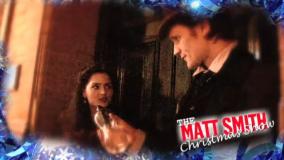
Today's Adventure Calendar release by the BBC features a behind-the-scenes video entitled The Matt Smith Christmas Show, in which the actor chats to new co-star Jenna-Louise Coleman, plus Kat from Costumes!
Tuesday, 18 December 2012 - Reported by Chuck Foster
The BBC have announced that it is to launch its BBC Entertainment channel in Burma from next year. The pay-TV channel will launch from 1st January 2013 alongside BBC World News and CBeebies, which will join the BBC World Service broadcast through the region's Forever Group.
BBC Entertainment showcases the best comedy, drama and light entertainment from the BBC and other UK production houses; this of course includes Doctor Who - so will mark the first time the series has been broadcast in the country!
I am pleased to be able to announce the launch of the BBC channels in Burma. We are very pleased to be part of Burma’s growing economy, and excited to be delivering our wide range of highly rated and award-winning programming - from programmes specially designed for pre-schoolers, to the best of UK comedy and drama and high quality international news to new viewers.
The BBC have also announced another first for Doctor Who, as BBC Entertainment is also introduced to Indonesia, to be broadcast via max3 from Biznet Networks. Mark Whitehead commented:
Indonesia is a very important part of BBC Worldwide’s growth strategy in Asia, and we are very pleased to be working with Biznet to launch our channels on their new platform. We are confident that the high quality and award winning programmes on BBC Entertainment, together with BBC World News and BBC Lifestyle will be popular with max3’s viewers.
Thursday, 13 December 2012 - Reported by John Bowman
The Entertainment Memorabilia auction held at Bonhams in London yesterday saw items from Doctor Who and its spin-off series fetch thousands of pounds, with the star item being the Nissan Figaro driven by Elisabeth Sladen as Sarah Jane Smith in The Sarah Jane Adventures going for £6,000 - the top end of its estimate.
Various costumes and props from Doctor Who, The Sarah Jane Adventures, and Torchwood went under the hammer but not everything was sold. A TARDIS exterior panel, listed as having been supplied by the BBC to the firm that made the title sequence for Sylvester McCoy's inaugural series as the Doctor, was withdrawn from the auction, having had an estimate of £400-500, and autographed scripts from Revelation of the Daleks, which had an estimate of £500-600, failed to sell.
The auction was held at Bonhams' Knightsbridge saleroom.
Full results of related auction items - sale price includes premium (estimate in brackets):
The sixth in our occasional series marking the 50th anniversary of events leading to the creation of a true television legend.
The story so far . . .
In the summer of 1962, the BBC commissioned a report into identifying specific science-fiction stories suitable for adapting for television.
The report started events that would lead to the transmission of the first episode of Doctor Who. Today, we examine the career of the man who was to reinvigorate BBC television drama and sow the seeds for an icon of the genre.
If there is one man who can claim to be the true father of Doctor Who, one man without whose inspiration, guidance, and care the series would never have been made, then that man is Sydney Newman, who joined the BBC on Wednesday 12th December 1962, exactly 50 years ago today. A brash, outspoken Canadian, his arrival at the BBC was a shock for an establishment more used to employing products of the country's public schools and university system. He arrived with a distinguished track record of success in production on both sides of the Atlantic, and with a brief to shake up the Corporation's drama department and bring it into the 1960s.
The Early Years:
Sydney Cecil Newman was born in Toronto on 1st April 1917 to a Russian Jewish immigrant father. His interest in art and the movies led him to attempt a career designing film posters, before switching to working in the film industry itself. A trip to Hollywood in 1938 led to an offer from the Walt Disney Company, a role he was unable to take up because of work permit issues. He returned to his native country, and during the Second World War he joined the National Film Board of Canada, first as an editor and later as a producer. He produced many documentaries and propaganda films during the war, and continued to work for the NFB in the post-war era. By 1952 he had produced some 300 short films, many of which were for Canada's government.
His excellence in the field led to him being appointed Supervising Director of Features, Documentaries, and Outside Broadcasts for the Canadian Broadcasting Corporation (CBC) in 1952, where he was involved in producing some of the earliest outside broadcasts on Canadian television, including early episodes of the iconic Hockey Night in Canada and the first Canadian Football League game to be shown on television. Despite having limited experience in drama, he was made Supervisor of Drama Production in 1954, and he used the role to encourage young writers and directors, including William Kotcheff and Arthur Hailey.
Among his productions for CBC was the highly successful Canadian Television Theatre presentations, and his work was being increasingly admired at home and abroad, including in Britain where several of his CBC productions were screened by the BBC. In an interview he explained that it was during a visit to the UK that he realised the kind of drama he wanted to produce when seeing John Osborne's play Look Back In Anger with then Head of BBC TV Drama Michael Barry. However, it was to be Howard Thomas - managing director of one of the new ITV network franchise holders, Associated British Corporation (ABC) - who decided Newman could provide him with the type of contemporary drama he wanted to broadcast, and recruited him to ABC in 1958.
Becoming Head of Drama at ABC, Newman took over the production of the popular Armchair Theatre anthology play series, networked nationally on Sunday evenings to huge audiences and which he insisted should use only original material that had been penned for television. He commissioned plays for the series by writers such as Alun Owen, Harold Pinter, and Clive Exton. Newman also devised a thriller series called Police Surgeon, starring Ian Hendry. Although not a success, Newman used elements from the series, including its star, to create The Avengers, a programme that would go on to achieve international success.
While at ABC, he also produced the children's science-fiction serial Target Luna and its three spin-offs - Pathfinders In Space, then Pathfinders To Mars, and finally Pathfinders To Venus. The four series, comprising 27 episodes, were written by Malcolm Hulke and Eric Paice and centred on the space exploits of the Wedgwood family. Actors who appeared in the different series included Michael Craze, Bernard Horsfall, Gerald Flood, and George Coulouris. The shows aired between April 1960 and April 1961, with the last series being the most ambitious and whose complexity and need to keep videotape editing to a minimum saw the decision made to have live action performed in the electronic studio and visual effects done on film. During the summer of 1961, a sci-fi version of Armchair Theatre was proposed by story editor Irene Shubik, and between June and September 1962 the resulting anthology series Out Of This World was shown, consisting of 13 one-hour dramas, with an extra introductory one - entitled Dumb Martian, produced by Newman - shown in the Armchair Theatre slot six days before Out Of This World started.
Arrival at the BBC:
Newman's success at ITV led to him being head-hunted by the BBC, and in 1961 he was offered the role of Head of Drama by the Corporation's Director of Television, Kenneth Adam. Although he accepted the position, he was forced by ABC to fulfil his contract, finally leaving the commercial network to take up his new appointment in December 1962. In a later interview he stated:
I'll be perfectly frank. When I got to the BBC and I looked my staff over I was really quite sick, because most of the directors there were people whose work I just did not like. I thought it was soft and slow and had no edge. Believe me, I had a bad Christmas, because I didn't know what to do - how to change those people who were stuck in their old ways, many of them having done their first television work at Alexandra Palace in 1938! Nice guys, willing guys, but most of them were just rigid!
He would spend five years with the BBC, but the influence of his tenure would ripple throughout the decades. While at the Corporation, he would oversee the arrival of new anthology series The Wednesday Play - a BBC equivalent of Armchair Theatre. He employed the likes of Dennis Potter, Jeremy Sandford, and Ken Loach, and under his watch seminal plays such as Cathy Come Home and Up the Junction were produced, tackling serious social issues of the day. Series produced under his aegis included the fantastical, Verity Lambert-produced Adam Adamant Lives!, the first two series of sci-fi anthology drama Out Of The Unknown (both produced by Shubik - now also working at the BBC), and legendary costume drama The Forsyte Saga - which became one of the most acclaimed and popular productions of his era, watched by 100 million people in 26 countries.
But it is for Doctor Who, now approaching its fiftieth anniversary, for which he remains best-known.
Future Head of Drama Shaun Sutton would comment in his book The Largest Theatre In The World:
Sydney Newman . . . burst into BBC Television Drama at its moment of expansion, seized the opportunity, and set a match to a dramatic bonfire that has warmed us all since.
Post-BBC:
Rather than having his contract renewed, Newman instead left the BBC to pursue a career as a film producer with Associated Film Producers, but no projects were to reach fruition and after being paid off when EMI took over in 1970 he decided to return to Canada.
Back home, he became Acting Director of the Broadcast Programmes Branch at the Canadian Radio-Television Commission, and later that year was appointed Government Film Commissioner and Chairman of the National Film Board of Canada. He continued to have a strong influence in the media, though more in an advisory rather than hands-on role. In 1981 he was awarded the Order of Canada, the country's highest civilian honour.
After the death of his wife, Newman returned to the UK and worked for a time at Channel 4 - and was also asked by BBC1 Controller Michael Grade in 1986 about how to revamp Doctor Who, though this was never taken further. He formally retired back to Canada, where he died of a heart attack in Toronto on 30th October 1997.
Compiled by: Marcus, Paul Hayes, Chuck Foster, and John Bowman
SOURCES: Doctor Who: The Early Years (Bentham; 1986); Encyclopedia of TV Science Fiction (Fulton; 2000); The Handbook (Howe, Walker, Stammers; 2005); The Creator (DWAS; 1998); Doctor Who: The Unfolding Text (Tulloch, Alvarado; 1983); Wikipedia; Who's Who
Friday, 23 November 2012 - Reported by Chuck Foster
The fifth in our occasional series marking the 50th anniversary of events leading to the creation of a true TV legend.
The story so far. In the summer of 1962, the BBC commissioned a report into identifying specific science-fiction stories suitable for adapting for television.
The report started events that would lead to the transmission of the first episode of Doctor Who on Saturday 23rd November 1963, exactly 49 years ago today. Today we examine the TV schedule of 50 years ago.
Exactly one year before Doctor Who started, the BBC was showing Captain Pugwash, the John Ryan cartoon series following the adventures of Captain Horatio Pugwash as he sailed the high seas in The Black Pig, assisted by trusty cabin boy Tom, and pirates Willy, Barnabas and Master Mate. The character had first been seen in the comic The Eagle in 1950, before appearing as a strip in Radio Times. He came to television in 1957, with the voices provided by Peter Hawkins.
Other highlights of the day included a Sid James comedy, the latest in the American series Dr Kildare, starring Richard Chamberlain, and a look at the work of the French actress, singer, screenwriter and director Jeanne Moreau, who had recently been seen in the film Jules and Jim.
Saturday evening saw The Lone Ranger being transmitted in what would become the Doctor Who slot. The episode shown was the final one in the fourth series of the American show. Starring Clayton Moore, it first aired in the States in 1957.
Home-grown entertainment came in the form of Mr Pastry's Pet Shop. Mr Pastry was a bumbling old man with a walrus moustache, who had adventures, partly slapstick, partly comic-dance, with two young friends. He was played by Richard Hearne, who would later be considered for the role of the Fourth Doctor.
Later in the evening, viewers could see the police drama Dixon of Dock Green and highlights from Bertram Mills Circus. Another American series, the Western Laramie, provided the main drama of the evening, with the 1946 psychological thriller The Spiral Staircase taking viewers up to the late news.
The late evening saw the debut of a new satirical series, That Was The Week That Was. Devised, produced and directed by Ned Sherrin and presented by David Frost, the programme - whose theme music was composed by Ron Grainer - would go on to be one of the most influential BBC series of the early Sixties, redefining the relationship between television and the political world. It was also a show that had a particular date with television history ahead of it a year later, when possibly its most famous edition - a shortened, non-satirical tribute to the assassinated US President John F Kennedy - was broadcast on the night of Saturday 23rd November 1963.
On consecutive Thursdays between 8th November and 29th November 1962, the sci-fi serial The Monsters was broadcast by the BBC. Based on a Panorama documentary concerning the Loch Ness Monster, the drama - written by Evelyn Frazer and Vincent Tilsley - centred on a zoologist on honeymoon searching for a similar creature and stumbling upon a bigger mystery to do with humanity's survival. The four 45-to-50-minute episodes were directed by Mervyn Pinfield and the cast included Philip Madoc, Clifford Cox, George Pravda, Clive Morton, Clifford Earl, and Norman Mitchell. The music was by Humphrey Searle, and Bernard Wilkie was one half of the team behind the special effects.
BBC TV's schedule for 23rd and 24th November 1962:
2.05pm - Pioneers of Social Change: Number 9 - Lloyd George
2.25pm - Interval
2.30pm - Watch With Mother
Closedown...
5pm - Tales of the Riverbank
5.10pm - Captain Pugwash
5.25pm - What's New?
5.50pm - News
6pm - View
6.50pm - Tonight
Trevor Philpott reports from Belgium on the problem of language. Part of the country speaks Flemish, the other French, leading to deep divisions, culminating in riots. The Government's solution is a language frontier. Plus, if you're looking for a change of menu this weekend, then maybe Louise Davies has an idea for you. Paella.
7.29pm - Headline News
7.30pm - Adventure: First Look at Africa
Series of films taken by world travellers & explorers. The story of an expedition into the regions of Uganda, virtually unknown to man, by a party of English & African students. Narrated by David Parry.
8pm - Dr Kildare
8.50pm - Citizen James: The Jury
Comedy series starring Sid James, featuring Sydney Tafler, Walter Hudd and Derek Nimmo.
9.15pm - News
Including reports on four British engineers killed in the Hungarian airliner crash in Paris and the murder of George Brinham, a member of the Labour National Executive who was killed in his flat by a 16-year-old boy.
9.25pm - Wednesday's Child, play
10.30pm - Film Profile: Jeanne Moreau
Derek Prouse talks to French actress Jeanne Moreau about her career.
11pm - News
11.10pm - Weather: Road Works Report
BBC: SATURDAY 24th November 1962
12.10pm (Welsh transmitters) - Telewele
12.35pm - Newyddion
12.40pm - Public Service announcements
12.45pm - Grandstand
including racing from Newbury, Ice skating, Championship Snooker from Birmingham, Rugby League: Hull v Wigan and Sports Results and News Service
5pm - The Lone Ranger: One Nation Indivisible
Two brothers working their way west after they lose their farm because of the war encounter the Lone Ranger and learn about what a future can be if they can let go of the past
5.25pm - Mr Pastry's Pet Shop: 2, A Very Dark Horse
5.50pm - News
5.53pm - Today's Sport
6pm - Juke Box Jury
6.30pm Dixon of Dock Green: A Home of One's Own. Police drama starring Jack Warner
7.15pm - Bertram Mills Circus
8pm - Laramie
8.45pm - Film: The Spiral Staircase
A serial killer is targeting women with 'afflictions'; one night during a thunderstorm, mute Helen feels menaced. Starring Dorothy McGuire, George Brent and Ethel Barrymore.
10.05pm - News, Weather
In America, enquiries have begun into the crash of the United Airlines Viscount in Maryland and seven-year-old Carl Connor, who was partially blind and deaf, was reunited with his grandmother after spending a night on Dartmoor. In Perth, the British Empire and Commonwealth Games were opened by the Duke of Edinburgh.
10.15pm - Saturday Sport
In the FA Cup there were no shocks, with Hinckley scoring two goals against Queen's Park Rangers' seven.
10.50pm - That Was The Week That Was
New topical satire programme presented by David Frost - with Kenneth Cope, David Kernan, Roy Kinnear, Millicent Martin, Lance Percival, and Willie Rushton.
The BBC faced competition for viewers from its commercial rival, ITV, which had been launched under the auspices of the now-defunct Independent Television Authority (created by The Television Act of 1954) to break the corporation's TV monopoly.
The first ITV station to launch was Associated-Rediffusion on 22nd September 1955, serving the London area. By 14th September 1962, with the start of WWN (the transmission name of Teledu Cymru for Wales West and North), the UK and Channel Islands were covered by the regional ITV network, with separate franchises for weekdays and weekends.
Each service sought to reflect its regional identity by having its own programmes in opt-out slots, as well as what it thought viewers would like to see from programmes made outside the region (eg, on Friday 23rd November between 5.25pm and 5.55pm, viewers in the Southern and Associated-Rediffusion areas were watching the antics of Yogi Bear while their counterparts in the Midlands were enjoying the exploits of Supercar on ATV, those in south Wales and the west of England were being entertained on TWW by The Adventures of Robin Hood (co-starring John Arnatt), people in the Anglia region had Mr Ed, Granada was showing The Terrific Adventures of the Terrible Ten, while Westward was airing National Velvet, etc), so to give a full picture of what was being aired when on ITV across the network on each day would result in a list far too long and - at times - irrelevant for the purposes of this feature.
Instead, here, as far as research allows, is what would have been seen by viewers tuning into their ITV channel on both days:
ITV: FRIDAY 23rd November 1962
12.45pm - 2.35pm: Very few ITV stations broadcasting, but ATV had Thought For The Day at 12.45pm, followed by Lunch Box between 12.47pm and 1.25pm, while Anglia began at 1.35pm by covering the Central Norfolk by-election, and both Granada and TWW started schools broadcasting at 1pm
2.35pm - 3.41pm: For Schools
4.45pm - Small Time (Willum's Tea Party) Some ITV stations only
5pm - Street of Adventure, presented by Hugh Moran
5.25pm - Opt-outs (see above)
5.55pm - News
6.05pm - Regional News
6.10pm - 7pm: Opt-outs (including, at different times, Day By Day, Out Of Town, Close-Up, Top O' The Shop, Midland Profile, Arena, People And Places, The Jim Backus Show, and Westward Diary)
7pm - Take Your Pick, presented by Michael Miles
7.30pm - Emergency Ward 10
8pm - 9pm: Opt-outs (including, at different times, I'm Dickens . . . He's Fenster, starring Marty Ingles and John Astin, Bonanza, The Dave King Show, Comedy Hour, and Police Five)
9pm - News
9.15pm - Television Playhouse: The Road To Anywhere, with Sam Kydd and Betty Baskcomb
10.15pm - midnight: Opt-outs (including, at different times, The Verdict Is Yours: Regina vs Hoskins, The Sword In The Web - The Munition Factory, Adventures In Paradise, Now You're Talking, White Hunter, Tightrope, and The Unsleeping Sword)
Some stations had closed before midnight after the weather forecast or the epilogue, but shortly after midnight, following the weather forecast on Southern, the ITV network had closed down for the day.
ITV: SATURDAY 24th November 1962
1.15pm - News
1.20pm - 5pm: Sport and results
5pm - 5.15pm: Opt-outs (including It's A Model World, introduced by Charles Oates, Bugs Bunny, The Wizard of Oz, and Meet Foo Foo)
5.15pm - City Beneath The Sea (Episode 2 - Escape To Aegiria)
5.45pm - News
5.50pm - Thank Your Lucky Stars, introduced by Brian Matthew (except Anglia, which had the weather followed by The Flintstones and Popeye)
6.30pm - 8.25pm: Opt-outs (including Cheyenne, Bonanza, Man of the World, and Surfside)
8.25pm - Bruce's Show, hosted by Bruce Forsyth, starring Frank Ifield and Bill Howes
9pm - News
9.10pm - 10.05pm: Opt-outs (including 87th Precinct, Ben Casey, and Hawaiian Eye)
11pm - 11.50pm: Opt-outs (including, at different times, On The Braden Beat, ABC At Large, Broadway Goes Latin, Hennesey, and The Sword In The Web)
11.50pm: News and, on most stations, weather (all but TWW, which showed The Sword In The Web at 11.05pm, followed by the weather)
11.55pm - Epilogue (only some stations; weather forecast on Southern; Faith For Life on Westward)
On Saturday 24th November 1962, The Times ran a feature in its Notes On Broadcasting section, headlined Viewers Begin To Make Themselves Felt, in which its "Special Correspondent" said that "by general consent" the current season's television had "been one of the most disastrous in terms of quality since the Independent Television Authority came into operation."
Reference was made to The Pilkington Committee report on broadcasting, published in June 1962 at a cost of £45,450. Among a number of things, the inquiry had criticised ITV's "triviality" and backed T S Eliot's evidence statement to the committee that "Those who aim to give the public what the public wants begin by underestimating the public taste; they end by debauching it".
The author of the feature bemoaned the fact that "after the summer doldrums, the unveiling of the autumn schedule with a blare of publicity trumpets brought only weaker and worse." They noted that the best of the American shows had been replaced by "feeble American derivatives or even feebler British substitutes", citing 87th Precinct, which took over from Naked City on ITV, as an example. Withering criticism was also levelled at The Saint and Ghost Squad, both of which were labelled "ineffectual".
On the positive side, it was noted that viewers' response had been so bad that the ITV companies were being forced to rethink things, an example being Associated-Rediffusion's sitcom It's A Living, starring Jimmy Jewel and Ben Warriss, being deemed so bad it was unceremoniously dumped after four episodes when it should have enjoyed a 13-week run. There was also reportedly such a negative reaction to ATV's Ghost Squad "that it suddenly disappeared for a week or two and re-emerged with some bland recasting . . . and a much livelier approach to scripting and direction."
Similarly, the Granada sitcom Bulldog Breed (starring Peter Butterworth and Geoffrey Palmer) disappeared from the schedules after six weeks, one week before it was supposed to end, while another Granada series, The Verdict Is Yours, which dramatised real trials, had started with a Monday evening peak-time slot but got ignominiously bumped by Rawhide to post-10pm on Fridays.
However, the BBC wasn't "in any position to congratulate itself", said the writer, noting that the corporation was relying on "tried and true favourites" for major audience pulling power but that these were starting to become "increasingly faded and routine", with Z-Cars and Maigret both being singled out as guilty parties.
What this all meant, believed the writer, was not necessarily that bad TV was driving out good but that TV companies were beginning to adopt "a far less cavalier attitude to viewers' wishes" than had previously been the case, since in the past unpopular programmes had been allowed to "limp along" and stay the course but now "programmes which have gone are precisely those which the higher-browed critics would agree were not worth preserving."
The two-channel television viewers of 1962 would be overwhelmed at the multitude of ways to watch a multitude of programmes across a multitude of channels that exist half a century later; but, perhaps, they would be less surprised at the mix of shows that are still broadcast on the main two channels from their time: 1962 had Doctor Kildare, 2012 has Casualty, likewise Dixon of Dock Green/Midsomer Murders, That Was The Week That Was/Have I Got News For You, and - well into his fifth decade on television - all-round performer Bruce Forsyth still occupies a prime-time Saturday evening slot! (Two other long-lived shows of note are Coronation Street which commenced in 1960, and The Sky At Night which launched in 1957 and is still presented by Sir Patrick Moore.)
BBC1: FRIDAY 23rd November 2012
6.00am - Breakfast
9.15am - Neighbourhood Blues
10.00am - Homes Under The Hammer
11.00am - Watchdog Daily
11.45am - Cash in the Attic
12.15pm - Bargain Hunt
1.00pm - BBC News
1.30pm - Regional News programmes
1.45pm - Doctors
2.15pm - Escape to the Country
3.00pm - BBC News
3.05-5:15pm CBBC
5.15pm - Pointless
6.00pm - BBC News
6.30pm - Regional News programmes
7.00pm - The One Show
7.30pm - Nigel Slater's Dish of the Day
8.00pm - EastEnders
8.30pm - Outnumbered
9.00pm - Have I Got News For You
9.30pm - Me and Mrs Jones
10.00pm - BBC News
10.35pm - The Graham Norton Show
11.20pm - The National Lottery Draws
11.30pm - Live at the Apollo
Midnight - EastEnders (omnibus)
ITV1: FRIDAY 23rd November 2012
6.00am - Daybreak
8.30am - Lorraine
9.25am - The Jeremy Kyle Show
10.30am - This Morning
12.30pm - Loose Women
1.30pm - ITV News
2.00pm - Crime Stories
3.00pm - Dickinson's Real Deal
4.00pm - Midsomer Murders
5.00pm - The Chase
6.00pm - Regional news programmes
6.30pm - ITV News
7.00pm - Emmerdale
7.30pm - Coronation Street
8.00pm - Island Hospital
8.30pm - Coronation Street
9.00pm - I'm A Celebrity... Get Me Out Of Here
10.30pm - ITV News
11.10pm - Accepted
BBC1: SATURDAY 24th November 2012
6.00am - Breakfast
10.00am - Saturday Kitchen Live
11.30am - Baking Made Easy
Midday - BBC News
12.15pm - Football Focus
1.00pm - Bargain Hunt
2.00pm - Escape to the Country
3.00pm - Formula One Live: Brazilian Grand Prix - Qualifying
Tuesday, 20 November 2012 - Reported by Chuck Foster
Bonhams have now released the catalogue for their next Entertainment Media Auction, which once again contains a number of items related to Doctor Who and its spin-offs. The usual assortment of costumes and props are available to bid upon, which also includes costumes worn by John Barrowman and Elisabeth Sladen in their respective roles as Jack and Sarah. Other highlights include a TARDIS phone panel, SV7's costume from The Robots of Death, original paperwork from Planet of the Spiders, Revelation of the Daleks and Remembrance of the Daleks, and Sarah's car from The Sarah Jane Adventures.
In blue-painted wood with white lettering Police Telephone Free For Use Of Public Advice And Assistance Obtainable Immediately Officers And Cars Respond To Urgent Calls Pull To Open (29x36.5cm).
According to information from the vendor, this was supplied by the BBC to CAL, the company that animated the 'Doctor Who' title sequence for the 24th Series in 1987. Oliver Elms, the BBC graphics designer who story-boarded the sequence, sent the Tardis panel to CAL to be used as part of the design process. From the livery and typeface, this is a 1980s-style door sign.
From March-May 1974, comprising rehearsal scripts for Episodes 1-5, and camera scripts for Episodes 3-6, with some annotations, together with a statement confirming provenance.
This story was the last to feature Jon Pertwee as the Doctor, ending with his transformation into Tom Baker. These scripts were obtained from a member of the Special Effects team.
An S.V.7 costume, comprising: a jacket, with quilted silver lamé sleeves, and plain cotton body, inscribed in black ink inside 'Miles Fothergill' ; a pair of three quarter length quilted silver lamé trousers, inscribed 'M.F.', together with a helmet, believed to be latter of coloured fibreglass, accompanied by a certificate of authenticity.
A full length RAF blue Great Coat, double breasted with domed gilt RAF-style buttons with raised wings and crown motif and Group Captain epaulettes, well worn with simulated bullet holes to each sleeve, labelled in the inside jacket pocket Angels, handwritten in blue ink John Barrowman, April '06, with attached BBC stocknumber
Comprises: maroon coloured velvet 'Karen Millen' coat with beige coloured stitching; a black and brown stripe dress of cotton/ lycra mix; cerise pink 'Karen Millen' cardigan with grey coloured pearlised buttons; a pair of maroon coloured tights and a pair of flat 'Bally' black knee high 'pony skin' boots, each with BBC asset number and label attached, boots size 37 (6)