The Fifth Doctor on BBC America

Wednesday, 8 May 2013 - Reported by Josiah Rowe
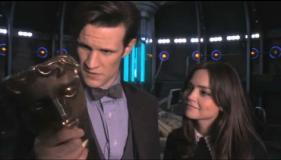
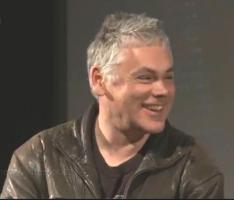
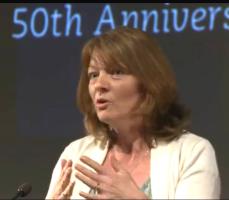
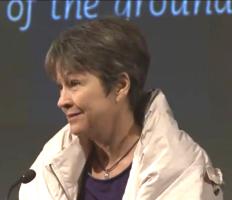
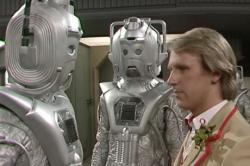
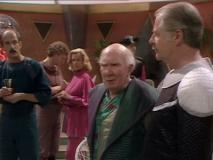
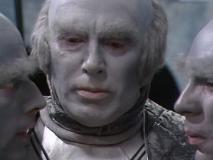
BBC America has chosen Earthshock to represent the Fifth Doctor in its Doctor Who: The Doctors Revisited celebratory season.

A documentary entitled The Doctors Revisited: The Fifth Doctor will air on Sunday, May 26 at 8pm Eastern/7pm Central, followed by the four-part story that reintroduced the Cybermen after an absence of nearly seven years.

The documentary will see Peter Davison, Steven Moffat, Hugh Bonneville, Sarah Sutton, and Mark Strickson discussing the Fifth Doctor. It will also feature other as-yet-unspecified contributors.

Earthshock first aired in 1982. As well as the return of the Cybermen, it featured the death of the Doctor's companion Adric, the only long-term television companion to die since the First Doctor's era.

BBC America is paying tribute to the programme's 50th anniversary by showing a story per Doctor per month.


FILTER: - Steven Moffat - USA - BBC America - Fifth Doctor - Peter Davison

Puffin Books: Tip of the Tongue by Patrick Ness

Tuesday, 7 May 2013 - Reported by Chuck Foster
Tip of the Tongue, by Patrick Ness (Credit: Puffin Books)The writer of the fifth in the Puffin Books series of e-books has been revealed to be Patrick Ness, the multi-award winning author of the Chaos Walking trilogy.

Tip of the Tongue
Written by Patrick Ness
Published 23rd May 2013

In 1945, a strange new craze for Truth Tellers is sweeping the kids of small-town America. The Fifth Doctor and Nyssa soon arrive to investigate the phenomenon, only to discover that the actual truth behind the Truth Tellers is far more sinister than anyone could have imagined...

Born in Virginia, USA Patrick Ness spent his upbringing in the states of Hawaii, Washington and California before moving permanently to the UK. He is the author of the Chaos Walking trilogy which established him as one of the most original and exciting writers of today. The trilogy has won many awards including the Guardian Children’s Fiction Prize, the Costa Children’s Book Award, the Booktrust Teenage Prize and the CILIP Carnegie Medal. Patrick’s sixth book A Monster Calls received high critical acclaim and is the winner of the Children’s Book of the Year Award at the Galaxy National Book Awards, the Red House Children’s Book Award and the UKLA Children’s Book Prize. In June 2012, A Monster Calls became the first book ever to win both prestigious CILIP Carnegie and Kate Greenaway Medals. His highly anticipated new novel for adults, The Crane Wife, was inspired by a Japanese folk tale and just published by Canongate in April 2013. A daring new YA novel More Than This is forthcoming later this year from Walker (Candlewick in the US).

Ness commented:
The Fifth Doctor is always the Doctor I thought most likely to be a novelist. People sometimes call him slightly passive, but I think it's more that he's observing, watching, waiting on the fringe to make his move. Just like any good writer. Which is why I've made this story one of those – which I've always liked – where the Doctor stays a bit out of the action and we see what happens through a non-canon character and get a whole different point of view of all the strange things happening. It's a bit how it feels when you watch the show as a young viewer.

A video of the author will be released on YouTube by BBC Worldwide later in the month, with the book itself coming out on the 23rd May.


FILTER: - Online - Books - WHO50 - Fifth Doctor

An Unearthly Series - The Origins of a TV Legend

Saturday, 4 May 2013 - Reported by John Bowman
Nothing At The End Of The Lane
The tenth in our series of features looking at events leading to the creation of a true TV legend.

The story so far: After a number of meetings and reports within the BBC to decide on a new TV show to fill a scheduling gap late on Saturday afternoons, drama boss Sydney Newman has given the go-ahead for a science-fiction series of serials featuring four time-travellers. One of those travellers will be a mysterious, grumpy, frail, and elderly man on the run and cut off from his own distant civilisation. As the programme - still without a title - takes embryonic form, it has been decided that it will be made at Lime Grove, with recordings starting weekly on Friday 5th July 1963 and the transmission of the first of 52 episodes scheduled for Saturday 27th July.

Round about the beginning of May 1963 - 50 years ago this month - BBC staff director and producer Rex Tucker is placed in temporary charge of the programme while the search is made for somebody to take on the role of producer permanently. Tucker is a BBC veteran who has experience of classic serials and drama for children, and at a meeting with Newman he is told the format of the new series. With them is Richard Martin, who has recently finished the BBC's training course for directors, and the idea is that Tucker will helm the first serial and Martin other early ones.

During later talks, the fledgling show is finally given a name - Dr. Who - with Newman being credited as the person who came up with it

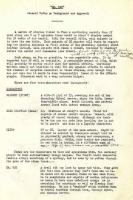
Script writer Cecil Edwin "Bunny" Webber had earlier drawn up an initial character and set-up plan. After some robust feedback from Newman, he now comes up with a draft document entitled General Notes on Background and Approach, aimed at potential writers for the show. Running to three and a half pages, it provides outlines for the four main characters, all of whom apart from the Doctor are given proper names for the first time. It also makes a bold suggestion as to how the space-time machine could be realised, gives the first episode its title, and describes the overall continuity of the series, its format, and what is being looked for in terms of stories.
"DR. WHO"

General Notes on Background and Approach


--------------

A series of stories linked to form a continuing serial; thus if each story ran 6 or 7 episodes there would be about 8 stories needed for 52 weeks of the serial. With the overall title, each episode is to have its own title. Each episode of 25 minutes will begin by repeating the closing sequence or final climax of the preceding episode; about halfway through, each episode will reach a climax, followed by blackout before the second half commences (one break).

Each story, as far as possible, to use repeatable sets. It is expected that BP [back projection] will be available. A reasonable amount of film, which will probably be mostly studio shot for special effects. Certainly writers should not hesitate to call for any special effects to achieve the element of surprise essential in these stories, even though they are not sure how it would be done technically: leave it to the Effects people. Otherwise work to a very moderate budget.

There are four basic characters used throughout:-

CHARACTERS


BRIDGET (BIDDY)
A with-it girl of 15, reaching the end of her Secondary School career, eager for life, lower-than-middle-class. Avoid dialect, use neutral accent laced with latest teenage slang.

MISS MCGOVERN (LOLA):
24. Mistress at Biddy's school. Timid but capable of sudden rabbit courage. Modest, with plenty of normal desires. Although she tends to be the one who gets into trouble, she is not to be guyed: she also is a loyalty character.

CLIFF
27 or 28. Master at the same school. Might be classed as ancient by teenagers except that he is physically perfect, strong and courageous, a gorgeous dish. Oddly, when brains are required, he can even be brainy, in a diffident sort of way.

These are the characters we know and sympathise with, the ordinary people to whom extraordinary things happen. The fourth basic character remains always something of a mystery, and is seen by us rather through the eyes of the other three....

DR. WHO A frail old man lost in space and time. They give him this name because they don't know who he is. He seems not to remember where he has come from; he is suspicious and capable of sudden malignance; he seems to have some undefined enemy; he is searching for something as well as fleeing from something. He has a "machine" which enables them to travel together through time, through space, and through matter.

- 2 -
QUALITY OF STORY

Evidently, Dr. Who's "machine" fulfils many of the functions of conventional Science Fiction gimmicks. But we are not writing Science Fiction. We shall provide scientific explanations too, sometimes, but we shall not bend over backwards to do so, if we decide to achieve credibility by other means. Neither are we writing fantasy: the events have got to be credible to the three ordinary people who are our main characters, and they are sharp-witted enough to spot a phoney. I think the writer's safeguard here will be, if he remembers that he is writing for an audience aged fourteen... the most difficult, critical, even sophisticated, audience there is, for TV. In brief, avoid the limitations of any label and use the best in any style or category, as it suits us, as long as it works in our medium.

Granted the startling situations, we should try to add meaning; to convey what it means to be these ordinary human beings in other times, or in far space, or in unusual physical states. We might hope to be able to answer the question: "Besides being exciting entertainment, for 5 o'clock on a Saturday, what is worthwhile about this serial?"

DR. WHO'S "MACHINE"

When we consider what this looks like, we are in danger of either Science Fiction or Fairytale labelling. If it is a transparent plastic bubble we are with all the lowgrade spacefiction of cartoon strip and soap-opera. If we scotch this by positing something humdrum, say, passing through some common object in [the] street such as a night-watchman's shelter to arrive inside a marvellous contrivance of quivering electronics, then we simply have a version of the dear old Magic Door.

Therefore, we do not see the machine at all; or rather it is visible only as an absence of visibility, a shape of nothingness (Inlaid, into surrounding picture). Dr. Who has achieved this "disappearance" by covering the outside with light-resistant paint (a recognised research project today). Thus our characters can bump into it, run their hands over its shape, partly disappear by partly entering it, and disappear entirely when the door closes behind them. It can be put into an apparently empty van. Wherever they go some contemporary disguise has to be found for it. Many visual possibilities can be worked out. The discovery of the old man and investigation of his machine would occupy most of the first episode, which would be called:-

"NOTHING AT THE END OF THE LANE"

The machine is unreliable, being faulty. A recurrent problem is to find spares. How to get thin gauge platinum wire in B.C.1566? Moreover, Dr. Who has lost his memory, so they have to learn to use it, by a process of trial and error, keeping records of knobs pressed and results (This is the fuel for many a long story). After several near-calamities they institute a safeguard: one of their number is left in the machine when the others go outside, so that at the end of an agreed time, they can be fetched back into their own era. This provides a suspense element in any given danger: can they survive till the moment of recall? Attack on recaller etc.

- 3 -

Granted this machine, then, we require exciting episodic stories, using surprising visual effects and unusual scenery, about excursions into time, into space, or into any material state we can make feasible. Hardly any time at all is spent in the machine: we are interested in human beings.

OVERALL CONTINUITY OF STORY

Besides the machine we have the relationship of the four characters to each other. They want to help the old man find himself; he doesn't like them; the sensible hero never trusts Dr. Who; Biddy rather dislikes Miss McGovern; Lola admires Cliff... these attitudes developed and varied as temporary characters are encountered and reacted to. The old man provides continuing elements of Mystery, and Quest.

He remains a mystery. From time to time the other three discover things about him, which turn out to be false or inconclusive (i.e. any writer inventing an interesting explanation must undercut it within his own serial-time, so that others can have a go at the mystery). They think he may be a criminal fleeing from his own time; he evidently fears pursuit through time. Sometimes they doubt his loss of memory, particularly as he does have flashes of memory. But also he is searching for something which he desires heart-and-soul, but which he can't define. If, for instance, they were to go back to King Arthur's time, Dr. Who would be immensely moved by the idea of the Quest for the Grail. This is, as regards him, a Quest Story, a Mystery Story, and a Mysterious Stranger Story, overall.

While his mystery may never be solved, or may perhaps be revealed slowly over a very long run of stories, writers will probably like to know an answer. Shall we say:-

The Secret of Dr. Who: In his own day, somewhere in our future, he decided to search for a time or for a society or for a physical condition which is ideal, and having found it, to stay there. He stole the machine and set forth on his quest. He is thus an extension of the scientist who has opted out, but he opted farther than ours can do, at the moment. And having opted out, he is disintegrating.

One symptom of this is his hatred of scientist [sic], inventors, improvers. He can get into a rare paddy when faced with a cave man trying to invent a wheel. He malignantly tries to stop progress (the future) wherever he finds it, while searching for his ideal (the past). This seems to me to involve slap up-to-date moral problems, and old ones too.

In story terms, our characters see the symptoms and guess at the nature of his trouble, without knowing details; and always try to help him find a home in time and space. Wherever he goes he tends to make ad hoc enemies; but also there is a mysterious enemy pursuing him implacably every when: someone from his own original time, probably. So, even if the secret is out by the 52nd episode, it is not the whole truth. Shall we say:-

- 4 -


The Second Secret of Dr. Who: The authorities of his own (or some other future) time are not concerned merely with the theft of an obsolete machine; they are seriously concerned to prevent his monkeying with time, because his secret intention, when he finds his ideal past, is to destroy or nullify the future.

If ever we get thus far into Dr. Who's secret, we might as well pay a visit to his original time. But this is way ahead for us too. Meanwhile, proliferate stories.

The first two stories will be on the short side, four episodes each, and will not deal with time travel. The first may result from the use of a micro-reducer in the machine which makes our characters all become tiny. By the third story we could first reveal that it is a time-machine; they witness a great calamity, even possibly the destruction of the earth, and only afterwards realize that they were far ahead in time. Or to think about Christmas: which seasonable story shall we take our characters into? Bethlehem? Was it by means of Dr. Who's machine that Aladin's [sic] palace sailed through the air? Was Merlin Dr. Who? Was Cinderella's Godmother Dr. Who's wife chasing him through time? Jacob Marley was Dr. Who - slightly tipsy, but what other tricks did he get up to that Yuletide?
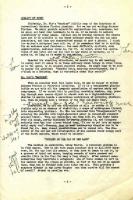
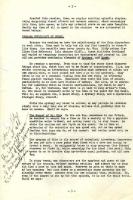
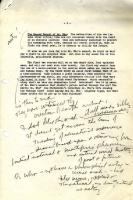
Newman's scribbled responses are heavily evident, and on occasion he doesn't pull any punches! Nearly half of the "Quality of Story" section is labelled "not clear", he is not so keen on the idea of the time machine being invisible, stating that a "tangible symbol" is needed, and he is completely opposed to the final section about the Doctor's secrets, writing "don't like this at all. Dr Who will become a kind of father figure - I don't want him to be a reactionary" next to the first secret, while the second secret is summarily dismissed with just one word: "nuts!"

One thing, however, that he is enthusiastic about is the time machine's inherent unreliability, writing "good stuff here" next to that section.

On the whole, though, Newman isn't keen on the proposed direction for the series. He writes: "I don't like this much. It all reads silly and condescending. It doesn't get across the basis of teaching of educational experience - drama based upon and stemming from factual material and scientific phenomena and actual social history of past and future. Dr Who - not have a philosophical arty - science mind - he'd take science, applied and theoretical, as being as natural as eating."

While Webber redrafts the format document to bring it more in line with Newman's vision, another name is thrown into the ring as a possible director on the new series. On Thursday 9th May, a memo is sent to script department boss Donald Wilson by children's programmes head Owen Reed (the actual Children's Department having been disbanded by Newman in January) urging him to consider Leonard Chase. Reed says Chase "has worked closely with Webber and has exactly the right flair for bold and technically adventurous 'through the barrier' stuff."

Four days later, it becomes apparent that (for undocumented reasons) the series' start has been put back to Saturday 24th August. On Monday 13th May, Drama Group Administrator Ayton Whitaker sends round a memo saying that recording will no longer begin on Friday 5th July, as was the original intention, but will now commence four weeks later on Friday 2nd August.

Next EpisodeRevision Time
SOURCES: BBC Archive - The Genesis of Doctor Who; The Handbook (Howe, Walker, Stammers; 2005)


FILTER: - The Story of Doctor Who

Harvest Of Time Book Details Released

Saturday, 27 April 2013 - Reported by John Bowman
BBC Books has released details of the forthcoming adventure Harvest of Time featuring the Third Doctor and the Master as well as UNIT.

Announced in July 2011, it has been written by Alastair Reynolds, who won a British Science Fiction Association award in 2001 for his novel Chasm City.

After billion of years of imprisonment, the vicious Sild have broken out of confinement. From a ruined world at the end of time, they make preparations to conquer the past, with the ultimate goal of rewriting history. But to achieve their aims they will need to enslave an intellect greater than their own . . .

On Earth, UNIT is called in to investigate a mysterious incident on a North Sea drilling platform. The Doctor believes something is afoot, and no sooner has the investigation begun when something even stranger takes hold: the Brigadier is starting to forget about UNIT's highest-profile prisoner. And he is not alone in his amnesia.

As the Sild invasion begins, the Doctor faces a terrible dilemma. To save the universe, he must face his arch-nemesis – the Master.

The 386-page book, which has an RRP of £16.99, will be published on Thursday 6th June and is available to pre-order.

Reynolds gained a PhD in astronomy and worked as an astrophysicist for the European Space Agency before becoming a full-time writer. His book Revelation Space was short-listed for both the Arthur C Clarke and BSFA Awards, while House of Suns was short-listed for the Arthur C Clarke Award.


FILTER: - Merchandise - Third Doctor - Books - BBC

AudioGo: May releases

Saturday, 27 April 2013 - Reported by Chuck Foster
May will see the release by AudioGo of the next encounter for the Doctor in their ongoing 50th Anniversary series Destiny of the Doctor, this month reaching his fifth incarnation. Meanwhile, the latest audio adaption of the Target novelisations takes listeners on a trip to Peladon with the Third Doctor. Plus, readers also enter our competitions to be in with a chance to win copies.

Destiny of the Doctor: Smoke and Mirrors (Credit: AudioGo)Destiny of the Doctor: Smoke and Mirrors
Starring Janet Fielding, with Tim Beckmann

The Doctor answers a psionic distress call sent from England in the 1920s. There, in the environs of a fairground, he is reunited with an old friend: Harry Houdini. To Adric and Nyssa the name means very little, but to the Doctor's companion Tegan he is a legend. Escape artist extraordinaire, Houdini's reputation will last for decades. But how does Houdini know so much about Tegan herself? Is it really just guesswork, as he says? Is Houdini right to be concerned about the fairground's fortune teller, who claims to have supernatural skills? Both he and the Doctor suspect an alien influence may be at work.

What neither the Doctor nor his friends realise is that, somewhere in the shadows, a sinister and all too familiar presence is lying in wait for them...

Doctor Who: Smoke and Mirrors (Destiny of the Doctor 5) is an original adventure by Steve Lyons, a prolific writer of Doctor Who fiction, and is available as a CD or download from 2nd May. It’s performed by Janet Fielding, who played Tegan in the original TV series, and Tim Beckmann. The series is produced for AudioGO by Big Finish Productions.

To be in with a chance to win one of three copies of Smoke and Mirrors courtesy of AudioGo, answer the following question:
As mentioned above, Harry Houdini is an old friend of the Doctor's, and he recently featured in a festive online tale alongside the Eleventh Doctor - what was the name of that story?
Please send your answer to smoke-competition@doctorwhonews.net with the subject "Now get out of that!", along with your name, address, and where you saw this competition. Only one entry is allowed per household. The competition is open worldwide, and the closing date is the 5th May 2013.

Doctor Who and The Curse of Peladon, read by David Troughton (Credit: AudioGo)Doctor Who and The Curse of Peladon
Written by Brian Hayles
Read by David Troughton

When the TARDIS materializes on the primitive planet Peladon, the Doctor and Jo become embroiled in political machinations. What is the secret behind the killings on the planet, and how are his old enemies the Ice Warriors involved?

Again, the terrifying cry rang out. The Doctor quickened his pace along the gloomy tunnels of the castle. Suddenly, from the darkness lumbered the mighty Aggedor, Royal Beast and Protector of the Kingdom of Peladon! The Doctor fumbled in his pocket. Would the device work? As he trained the spinning mirror on the eyes of Aggedor, the terrible claws came closer and closer...

What is the secret behind the killings on the planet of Peladon? Is Aggedor seeking revenge because the King of Peladon wants his kingdom to become a member of the Galactic Federation? Will the Doctor escape the claws of Aggedor and discover the truth?

Doctor Who and the Curse of Peladon is Brian Hayles’ complete and unabridged novelisation, first published in 1974 by Target Books. It is read by David Troughton, who played King Peladon in the original BBC TV episodes. It is based on the original 1972 TV serial of the same name, featuring the 3rd Doctor (as played by Jon Pertwee). Doctor Who and the Curse of Peladon is available as an audiobook from AudioGO, on CDs or as an audio download, from 2nd May.


To be in with a chance to win one of three copies of The Curse of Peladon courtesy of AudioGo, answer the following question:
David Troughton played Peladon in the tale, but this wasn't his first appearance in Doctor Who - name his first role.
Please send your answer to peladon-competition@doctorwhonews.net with the subject "By the spirit of Aggedor!", along with your name, address, and where you saw this competition. Only one entry is allowed per household. The competition is open worldwide, and the closing date is the 5th May 2013.

In addition, AudioGo have also released an audio adaptation of the latest adventure for the Eleventh Doctor, Plague of the Cybermen:

Plague of the Cybermen (Credit: AudioGo)Plague of the Cybermen
Written by Justin Richards
Read by David Warner, with Nicholas Briggs as the Cybermen

When the Doctor arrives in the 19th-century village of Klimtenburg, he discovers the residents suffering from some kind of plague - a 'wasting disease'. The victims face a horrible death - but what's worse, the dead seem to be leaving their graves. The Plague Warriors have returned ...

The Doctor is confident he knows what's really happening; he understands where the dead go, and he's sure the Plague Warriors are just a myth. But as some of the Doctor's oldest and most terrible enemies start to awaken he realises that maybe - just maybe - he's misjudged the situation.
 

To be in with a chance to win one of three copies of Plague of the Cybermen courtesy of AudioGo, answer the following question:
Plagues, viruses and Cybermen go hand-in-hand, but in which story did they spread 'infection' through the use of sugar?
Please send your answer to plague-competition@doctorwhonews.net with the subject "You know our ways!", along with your name, address, and where you saw this competition. Only one entry is allowed per household. The competition is open worldwide, and the closing date is the 5th May 2013.


FILTER: - Merchandise - Audio - Third Doctor - Competitions - Eleventh Doctor - WHO50 - Fifth Doctor

DVD Update: The Green Death (SE)

Friday, 26 April 2013 - Reported by Chuck Foster
The Green Death. Photo: BBCThe BBFC have now classified the special features that are to appear on the forthcoming special edition release of The Green Death, currently scheduled for the 5th August in the United Kingdom.

00:11:38:12 VISUAL EFFECTS (FEATURETTE)
00:07:40:04 (STEWART BEVAN INTERVIEW)
00:05:38:01 WHAT KATY DID NEXT (FEATURETTE)
00:06:49:21 (ROBERT SLOMAN INTERVIEW)
00:10:51:09 GLOBAL CONSPIRACY? (FEATURETTE)
00:02:27:21 (WALES TODAY) (ARCHIVAL TV FOOTAGE)
00:00:38:18 (EASTER EGG NO. 2)
00:09:49:23 THE GREEN DEATH - PHOTO GALLERY
00:23:07:06 DR. FOREVER! - THE UNQUIET DEAD (FEATURETTE)
00:26:21:18 THE ONE WITH THE MAGGOTS - MAKING THE GREEN DEATH
00:01:23:10 ORIGINAL CONTINUITY ANNOUNCEMENTS -
SATURDAY MAY 12TH 1973 TO SATURDAY JUNE 16TH 1973 - 5.50PM BBC1
(EASTER EGG NO. 1)
00:02:43:03 REPEAT CONTINUITY ANNOUNCEMENTS -
SUNDAY JANUARY 2ND 1994 TO SUNDAY FEBRUARY 6TH 1994 - 12.00PM BBC2
(EASTER EGG NO. 1)

Features that are new to this DVD release are highlighted above.


Since the previous update, the current series finale The Name of the Doctor has been classified for its DVD release as part of the Series 7 Part 2 boxed set in May, with a running time of 44m 26s.


FILTER: - Third Doctor - Classic Series - Blu-ray/DVD

An Unearthly Series - The Origins of a TV Legend

Friday, 26 April 2013 - Reported by John Bowman
Journey into the Unknown
The ninth in our series of features looking at events leading to the creation of a true TV legend.

The story so far: Initial planning has taken place on a new science-fiction series to run on BBC television on Saturday evenings, filling the gap between Grandstand and the pop music show Juke Box Jury. Following a meeting on 26th March 1963, chaired by script department head Donald Wilson, the script writer Cecil Edwin "Bunny" Webber produces an initial character and set-up plan, while his colleague Alice Frick writes up a report of the meeting, outlining ideas on transport, communication, themes, and format.

It was in April 1963, 50 years ago this month, that BBC Head of Drama Sydney Newman, the man who had commissioned the new series, considered the initial programme suggestions. The reports, which exist in the BBC's written archives, show Newman making a number of handwritten comments showing his thoughts on the proposals. He was not keen on the idea of a flying saucer, saying it was "Not based in reality - or too Sunday press", and he dismissed the idea of a team of troubleshooters with the one emphatic word "No". Newman was keen to get a youngster involved in the action. "Need a kid to get into trouble" he wrote, and "make mistakes". In addition, he gave short shrift to Webber's thoughts on villains - the possibility of a recurring one, perhaps a politician or industrialist, or "ad hoc villains for each story, as needed" - bracketing the whole section of the plan "corny".

Overall, Newman thought the proposals from the team were too unimaginative and highbrow. He was trying to bring fresh thinking to the BBC and was worried the idea was too safe, too derivative of other BBC dramas. He felt a better model for the series would be Pathfinders - three serials he produced at ABC - where a strong storyline was followed each week with a dramatic cliffhanger in much the same way as the classic cinema serials such as Flash Gordon had done. Indeed, the BBC had produced similar serials, such as Stranger From Space, The Lost Planet, and Return To The Lost Planet. (Stranger From Space - part of the children's programme Whirligig - can lay claim to being Britain's first TV sci-fi cliffhanger serial. It ran for two series in 1951 and 1952 and included in its cast Valentine Dyall and Peter Hawkins.)

One thing of which Newman did approve, though, was the idea of a time machine. He later recalled:
How wonderful, I thought, if today's humans could find themselves on the shores of England seeing and getting mixed up with Caesar's army in 54BC, landing to take over the country; be in burning Rome as Nero fiddled; get involved in Europe's tragic Thirty Years War; and so on.
Newman was happy with the proposal of a handsome young man hero to lead the action, alongside a well-dressed heroine aged about 30. As noted above, he wanted a young teenager to join the action, to be a link with the many children he expected to be watching. However, it was with the third character outlined in the report - the maturer man aged 35 to 40 "with some 'character' twist" - that he had the most influence, and he set out his thoughts on this in a memo to Wilson, replacing Webber's maturer man with somebody quite different . . .

Although now lost from the archives, Newman's memo detailed the character who would lead the show and become its focus. Newman wanted a grumpy, frail, old man to be the centre of the series, a man on the run, cut off from his own faraway planet and highly advanced people from whom he had fled, stealing a time machine in the escape. Newman even gave the character a name, and in doing so, 50 years ago this month, he created one of the most iconic characters in television history. This man would simply be known as the Doctor.

By now, the script department had made way for the serials department, of which Wilson was in charge, and it was this new department that would be tasked with making the new show.

While planning the basic set-up of the series, a number of decisions were being made on a more practical level, detailing just how the series would be made and how it would be resourced. The new series had been allocated Studio D at Lime Grove. The BBC had bought the Lime Grove studio complex in 1949 as a stop-gap to provide studio space in central London while the new Television Centre was being built at White City. The studios were built for film, where they were home to the Ealing comedies and the famous British film The Wicked Lady. Converted for use by television, they became home to many productions in the 1950s, including the famous dramatisation of Nineteen Eighty-Four starring Peter Cushing, as well as the comedy series Steptoe and Son (whose title music was composed by Ron Grainer) and the early soap opera The Grove Family, which took its title family from the studios, was created and written by Jon Pertwee's father and elder brother, Roland and Michael, and whose cast included Peter Bryant.

In a memo sent on Friday 26th April 1963, exactly 50 years ago today, Drama Group Administrator Ayton Whitaker set out the plans for the new series. The memo gives an intended transmission date of the end of July, some four months before the series would eventually appear. It sets out the budget - £2,300 per episode - and notes how facilities such as back projection and inlay would be needed.
I understand that facilities are available for recording the Saturday serial weekly in Studio D on Fridays, starting from 5 July (Week 27), the first transmission to be in Week 31 on Saturday 27 July.

The serials, which will in all run for 52 weeks, will average six episodes and every serial will require one week's filming at the Television Film Studios. For the most part this filming will be confined to special effects, but artists, with therefore attendant wardrobe and make-up facilities, will be required on occasions. The first two serials are each of four episodes.

. . .

Moving and Still BP [back projection] will be required in the studio on all recording days, so there should be a block booking for 52 weeks, starting on the Friday of Week 27. Inlay and overlay will also be required as a regular facility.

The series will cost £2,300 per episode, and an additional £500 will be needed to build the space/time machine which will be used throughout the 52 weeks.
He is subsequently told that the design department should be able to cope with the new series, so long as no more than 500 man-hours on the first episode and 350 man-hours per successive instalment are needed.

Next EpisodeNothing At The End Of The Lane
Compiled by:
Marcus and John Bowman
SOURCES: BBC Archive - The Genesis of Doctor Who; The Handbook (Howe, Walker, Stammers; 2005); Encyclopedia of TV Science Fiction (Fulton; 2000); BFI Screenonline


FILTER: - The Story of Doctor Who

DVD Update: Doctor Who: Regeneration

Thursday, 25 April 2013 - Reported by Chuck Foster
Doctor Who: Regeneration - R2 DVD Cover (Credit: BBC Worldwide)The BBC have finally confirmed that the Regeneration set that has been listed on Internet sites such as the BBC Shop and Amazon will indeed be released in June.

As the title implied, this release deals with the Doctor's regenerations, and will be presented as a limited edition, "coffee-table" book which will include six DVDs covering the adventures associated with the change of actor - and includes the premiere of the newly animation-enhanced The Tenth Planet on DVD.

The full list of stories are: The Tenth Planet, The War Games, Planet of the Spiders, Logopolis The Caves of Androzani, Time and the Rani, Doctor Who: The Movie, Bad Wolf/The Parting of the Ways, and The End of Time.

Regeneration will now be released on 24th June and not 10th as originally scheduled.


FILTER: - Eighth Doctor - Eleventh Doctor - WHO50 - Fifth Doctor - Tenth Doctor - Ninth Doctor

BFI Screenings: Fifth Doctor Guests And Sixth Doctor Title Announced

Wednesday, 24 April 2013 - Reported by John Bowman
Actors Peter Davison, Sarah Sutton, and Janet Fielding will join director Graeme Harper and Radiophonic Workshop composer Roger Limb as the special guests at the BFI Southbank big-screen showing of The Caves of Androzani next month.

The four-part story is being shown on Saturday 4th May to mark the Fifth Doctor's era, as part of the BFI's Doctor Who At 50 season.

The adventure saw the Doctor regenerate into his sixth incarnation, played by Colin Baker, and today the BFI revealed that the story picked to mark the Sixth Doctor's era will be The Two Doctors, to be shown on Saturday 15th June at 2pm.

The three-part adventure, written by Robert Holmes, co-starred Patrick Troughton as the Second Doctor and was first broadcast in 1985, pitting both Doctors against the Sontarans. It also saw the return of Frazer Hines as Second Doctor companion Jamie. Location filming was carried out in Spain.

BFI Champions and members are entitled to priority booking for the event, whose guests will be announced nearer the time, but because of the overwhelming popularity of the Doctor Who At 50 season a ballot system will be in operation once again for tickets. Two ballots are being run - one each for Champions and members - via e-mail to memberballot@bfi.org.uk. Champions can enter from Monday 6th May, while members can enter from Tuesday 7th May. Champions can enter both ballots.

The ballots will close on Friday 10th May and will be run over the weekend of 11th and 12th May, with all entrants being notified on Monday 13th May as to their success or failure. Any tickets that have been reserved for Champions and members through the ballot will be held until 8.30pm on Friday 17th May, and those left unclaimed will be released for public sale on Saturday 18th May.

However, on Wednesday 15th May the official Doctor Who Facebook page will have a small number of tickets set aside for purchase by members of the public, whereby people will have to correctly answer a question to be in with a chance of booking.

Although all the celebratory screenings have been immediate sell-outs, returns and stand-bys are a strong possibility, so if all else fails do keep checking with the BFI!


FILTER: - Special Events - Sixth Doctor - UK - BFI - WHO50 - Peter Davison

Details announced of Splendid Chaps: "Five/Fear"

Wednesday, 24 April 2013 - Reported by Adam Kirk
.As previously reportedSplendid Chaps is a year-long performance/podcast project to celebrate the 50th anniversary of Doctor Who hosted by comedian Ben McKenzie (Dungeon CrawlMelbourne Museum Comedy Tour) and writer John Richards (ABC1 sitcom OutlandBoxcutters podcast)

Described by its creators as part intellectual panel discussion, part nerdy Tonight Show, Splendid Chaps is a combination of analysis, enthusiasm and irreverence. The first episode went to number 1 on the iTunes TV & Film Podcast chart in Australia, and to number 4 in the UK.  The podcasts to the first few episodes are now available at www.splendidchaps.com or at  iTunes.

Tickets are now on sale for their 5th Doctor show!
On Sunday May 19 they’ll be celebrating the era of the 5th Doctor, the cricket-and-celery-loving Peter Davison, and exploring the notion of Fear in Doctor Who. When is Doctor Who scary, and why? Guests will include comedian Tegan Higginbotham (from comedy duo Watson and The Comedy Channel’s Whatever Happened To That Guy?) and horror author Narrelle M Harris. That’s at The Public Bar, 238 Victoria Street, North Melbourne, at 5pm.

Splendid Chaps: A Year Of Doctor Who: "Five: Fear"

Space: The Public Bar, 238 Victoria Street, North Melbourne
Time: Saturday 19 May 2013, 5 PM
Accessibility: This venue is wheelchair accessible.
Tickets: All tickets $15 (plus booking fee where applicable)
Bookings: via trybooking.com, or buy tickets at the door (subject to availability)
Podcast: not yet available, released 23 May 2013.

With thanks to John Richards


FILTER: - Special Events - Fan Productions - Fifth Doctor - Peter Davison - Australia