The publicity machine for
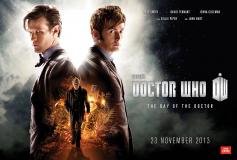
The Day of the Doctor has started to pick up speed now, with five key interviews and more pictures being released, as well as the announcement of the official trailer airing on BBC One.
Please note, the interviews may contain what some fans could consider spoilers, even though it is officially released information. Readers must therefore assume personal responsibility for clicking on "Reveal"!
Firstly,
Steven Moffat discusses - among other things - what it was like writing such an important episode and where he'll be watching it.
What is it like being the writer for the Doctor Who 50th special?
Since I was a little boy, the idea of writing a Doctor Who story at all was remarkable enough to me. But writing the 50th special was exciting and terrifying - everything that showbiz should be.
So where did the story for The Day Of The Doctor come from?
I didn't want this to just be a celebration of 50 years of the past. I wanted it to be a celebration of the mythology and legend of the Doctor and all that entailed.
This should be the first step on the next journey, guaranteeing the 100th anniversary. The story focuses on the most important thing that ever happened to the Doctor. We very rarely do that in Doctor Who as it's usually about the people the Doctor meets or the companions that travel with him. This time it's different.
The Day Of The Doctor welcomes back the shape-shifting Zygons, a monster we haven't seen since the 1970s. Why did you decide they were the ones to bring back?
The Zygons, without question, are a design classic. They are superb - brilliant from the voice, to the appearance. Essentially, we've resurrected exactly the same Zygon as Tom Baker fought back in the '70s. They are beautiful, and it'll show that the special looks forward to the future of Doctor Who and also celebrates the legend.
At the end of the last series we were introduced to John Hurt as the Doctor. What does John bring to the role and can you tell us anything about his Doctor?
With John Hurt we have serious acting royalty and that was the intent of John's character. John is one of the most distinguished film stars of British origin, one of the most distinguished actors this country has produced, and has now become part of Doctor Who mythology.
There have been Doctor Who anniversary specials before, which are so well loved. How do you think this one will be remembered?
There's only really been one anniversary special before and that was for the 20th anniversary with The Five Doctors. The Three Doctors wasn't an anniversary special as it was one year too early, but we remember it that way.
I adored The Three Doctors, it was brilliant, an accidental piece of magic. I also loved The Five Doctors. I did think that was the one where possibly the desire to celebrate overwhelmed the desire to tell a story. But I can't really begrudge it that!
The Day Of The Doctor will be the first time we see Doctor Who in proper 3D. Did you write the script with 3D in mind?
My first impulse was if we're going to do 3D, it had to be part of the plot. We actually have to make 3D part of the story and, if at all possible, to try and make 3D a bit scary. I wouldn't say it's in every scene, but there is an element of the show that exploits the fact of 3D.
The 50th special will mark the return of David Tennant to the role of the Tenth Doctor, starring opposite the Eleventh, Matt Smith. How was it having two Doctors on set?
It was eye-twisting at times. You don't quite realise how these two men have become hard-wired into your brain as the Doctor. Matt and David got on so well and their interaction on screen is a sublime double act. Matt said to me, "It's a bit like Laurel and Laurel. It's like Hardy didn't turn up." They are absolutely great together. Sometimes very, very, different - other times, in moments they choose together, they are exactly the same.
And seeing Billie and David on set together, how was that?
Seeing Billie and David standing on set together was quite epic. Billie told me that as she is very good friends with both Matt and David she felt quite torn and divided. She didn't know how to deal with both of them at the same time, so if she was talking to one, she would stroke the arm of the other.
And finally, where will you be watching the episode on 23rd November?
I've got two impulses. One is to watch it at home with my friends, particularly friends who made the show. My other impulse is to go out and join the party. But it's a difficult one. When Matt and I watched The Eleventh Hour we watched it many times before it went out. Then came the fateful day, 3rd April 2010. Matt came round to my house, my parents and his parents were there to watch the episode go out and have our future decided. Everyone sat down, but Matt and I couldn't stay in the room. So I might be watching it peering round my kitchen door with Matt.
Stepping back into the TARDIS for his penultimate ride,
Matt Smith takes on the role of the Doctor in his greatest adventure yet. Here he talks about being part of the epic 50th adventure.
What is it like starring in the 50th anniversary special, one of the biggest years for the show?
It's a thrill to be in the 50th anniversary. I feel very proud to be part of it and it's a credit to everyone who started the show back in the '60s that it's come this far. It's a great format and a great idea.
The Day Of The Doctor marks the return of David Tennant and Billie Piper, and we get the revelation of John Hurt's Doctor. What was it like working alongside them all?
It was a joy to work with David, Billie and John Hurt. I've worked with Billie before and I'd obviously seen all of David's work, especially as the Doctor. He's a brilliant actor and a brilliant Doctor. It's quite strange, I always sort of get that surreal thing of looking at David and thinking, "Oh my God, there's Doctor Who." And John is acting royalty. Another wonderful Doctor and again, a good bloke. I think looking back over my tenure on this show, one of the great privileges has been the quality of actors that you get to work with.
Was there any kind of competitiveness between the different Doctors and companions?
No, we're not competitive, I mean there's a funny bit in the script between the 10th and 11th Doctors comparing sonics, so there's competitiveness in the story, but not off-screen. We just had a laugh and it was exciting to see David back in the pin-striped suit and Converse. John only has to move his eyes and he floors you, and Billie is Billie. I adore Billie, so we had a great time.
Were there any moments when you were standing on the floor waiting for action to be called and thinking "Oh my goodness, I'm actually doing this"?
Of course, there's always those moments in Doctor Who when you're going, "Wow we're doing Doctor Who and there's David Tennant over there and John Hurt over there and Billie over there and there's a Redgrave over there." There are a lot of those moments when you make this show.
But I think the wonderful thing was there was great downtime. I just enjoyed spending time with David and obviously for me as well, as I am about to leave the show, it was really interesting to talk to him about that experience and his experience on the show, because it is a very individual experience playing the Doctor. It was quite nice to go, "What was that bit like for you?" and it was just sort of enlightening really.
Moving on to stunts, some pictures have been published of you hanging from the TARDIS in front of crowds in Trafalgar Square. What was that like and did you need to be convinced to go up there?
I was hoisted up over 90 feet, double Nelson's Column ....[DWN note: The monument is 170ft high], hanging on a wire under the TARDIS. They used the biggest crane I think they had ever brought to Trafalgar Square. I really had to persuade them to let me go up, but I had the most wonderful view of London. It was raining and really windy, but I loved it and would do it again. It was one of the rare brilliant opportunities that you only get with Who.
As well as being shown on BBC One, The Day Of The Doctor will be available in 3D to those with a 3D TV and in some cinemas. What was it like filming in 3D?
The rigs for the cameras are much heavier and poor Joe [Russell], who is our wonderful cameraman, had a very tough time of it. It was like having a six-year-old or seven-year-old child on your shoulder all day. There's just a lot more time, the technical process of filming everything is more laborious.
But also there are a lot of pluses and I'm really excited to see how Doctor Who lends itself to it, because I think as a show and a format it really suits the idea of being shot in 3D. I think it's good for a show like Doctor Who to be at the forefront of technology and that's what we've always been. It's always been at the front of the advancement in film and even with the wobbly sets, at least they were having a go and I think it's a good step forward. It's an evolution.
Last seen in his pin-stripe suit and trainers in 2010,
David Tennant returns as the 10th Doctor in the 50th anniversary special. Here he talks about rivalry between the Doctors and coming back to the show.
What is it like being part of the 50th in one of the biggest years for the show?
It's very exciting to be around for the big celebration episode. I think since I left, the expectation had been that I'd end up in this special, because there is a precedent for old Doctors coming back for a visit around the anniversary time. I was thrilled because it's a huge thing for Doctor Who and it's a huge thing for television in general. So few shows run beyond a few series and 50 years' worth is quite a legacy, so I'm very honoured to be part of that.
What is it like working with Matt and Jenna? Was there any rivalry or competitiveness between the two sets of Doctors and companions?
It's funny, I think people almost expected Matt and me to be at loggerheads, but we've really enjoyed it. I guess when you've played a character for a long time you kind of feel like you know how they'll react in most situations. It's delicious to be handed a situation that's completely new and a character meeting a version of himself is not something that you come across in a lot of drama. So to get to play that with someone as talented and as quick and brilliant as Matt is nothing short of jolly good fun.
You've probably seen some of the previous anniversary specials, but how do you think this one compares to them?
It's very hard to be objective about something you're in, especially when you set it up against things that you experienced as a child. But I certainly remember when The Five Doctors was on, it was electrically exciting. That was of course in the day when we didn't even have a video player. You couldn't revisit things, so the chance to see old Doctors that I had never seen on the telly at all acting with the current [Doctor] was fantastic. I hope that this will have some of that buzz for today's generation.
Do you still watch Doctor Who?
Of course. I watch it every time it's on, along with the rest of the nation.
How did you find filming in 3D compared to 2D?
Our job as actors remains the same really, but you're aware that there's a whole extra layer of technical stuff that has to be dealt with and the cameras are bigger. We shot a lot on this hand-held camera, which was quite trying for Joe, our intrepid camera operator, who has this enormous thing that he has to lug around and navigate around the set; he did it brilliantly. But it causes some headaches for the camera teams and for the post-production side of making it. We're not doing too much novelty-weaving into the lens for the 3D effect, but it gives it an extra zing.
What was it like working with Billie again?
It's always lovely to see Billie, and to be on set with her is a particular joy. She's one of my favourite actresses and one of my favourite people, so I was very happy to be in the same room as Billie.
Where will you be watching the episode?
Wherever I am in the world and whatever I'm doing, I'm sure I will make time for the Doctor Who 50th anniversary special.
During filming did you ever have pinch-yourself moments thinking, "God, I'm back" or anything like that?
I think the thing with filming Doctor Who is that there is so much excitement around it and there's so much enthusiasm for it that often the lead-up to getting here is more of a delight than shooting it.
Because once you're on set there’s a script and there's lines and you've got to get the scene shot and they are the pressures that filming always has. Really, you're just trying to film the scenes the best you possibly can, so you sort of put aside the idea that you're making something that is a moment in television history. The pressure of that would sort of paralyse you really.
Back in the TARDIS,
Jenna Coleman stars as companion to the Eleventh Doctor. Having met more Doctors than any other companion, this time she comes face to face with more than one Doctor at once.
What is it like starring in the 50th special, one of the biggest years for the show?
It's fantastic. I feel really spoilt to be honest and lucky to be in the show in the first place, but also to have come in at this time. Whilst we were filming it felt very celebratory and special. Working with David, Billie and John, I feel really pleased to be part of the whole thing.
What was it like working with David and Billie? Was there any competiveness between the different Doctors and companions?
I think there's a competitiveness in them that kind of brings out the best in the Doctor. You see it on set that they are so totally different Doctors, but they just complement each other. They make fun of each other mercilessly.
What were your thoughts when you first heard about John's character?
So, not only do we have David back, we also have John Hurt starring as the Doctor, which is massively exciting. And again, the three of them complement each other totally, and it utterly works. It's great to see all of them together.
There are some big stunts in this episode. What was it like filming in the TARDIS dangling from a crane in front of crowds in Trafalgar Square?
It's one of the major stunts that we did and one of the big opening sequences at the beginning of the episode. We actually filmed it in a couple of stages including at St Athan's airfield, where me and Matt were in the TARDIS being swung from side to side. Then, in the second half, we were actually lowered down into Trafalgar Square. I think it will be quite an iconic image, it certainly felt like that on the day.
I didn't get to do the really high stunt in Trafalgar Square, which I was devastated about, and was kind of stood around begging people to go up, but I got to do the end of it. I am quite scared of rollercoasters, but when you've got a camera pointing at you and loads of crew then you kind of just tend to be really brave. That's one of the thrills of the show.
What differences did you find filming in 3D compared to 2D?
Loads of differences. Well for a start, the cameras are massive, so you kind of can’t miss them and they're really heavy for the poor camera operators. The framing is quite different and when the Doctor points you can kind of really react to it. I just think the show lends itself so well and there are so many moments in it that will work really well in 3D. On the first day I saw Matt in the TARDIS in 3D it felt like the world was coming right out at you.
Finally,
Joanna Page shares her thoughts on this epic adventure:
What's it like being part of the 50th, one of the biggest years on the show?
It's amazing being part of the 50th anniversary. I just remember getting an email asking if I'd play Queen Elizabeth I, which in itself I couldn't believe because she's so iconic, even in the history of Doctor Who. I've always wanted to be in Doctor Who and now to be in it and playing Queen Elizabeth I is absolutely fantastic, so exciting.
And what did you do when you first found out about the news?
When I first found out about the news I phoned my mum and my dad and obviously told my husband, and then I sat down and read the script, because I couldn't wait to get my hands on it. I just couldn't believe that they had sent it to me, as it was like gold dust. There were all these rumours in the papers about what's happening, and so and so is coming back and I just thought I'm actually going to know what happens. I've never done a job where you have to keep a secret before and it's been really difficult, but also really exciting because you know and no-one else does.
You're playing royalty. Can we expect a Queen Elizabeth with a Welsh twang?
Well, it's very funny being one of the most well-known Welsh people and having to stand up and say, "How dare you, I'm the Queen of England." That did make me laugh, but no, I'm playing her with an English accent. But John Hurt said she actually wouldn't have had a very English accent, because there were so many different influences.
What was it like working Matt, David, Billie and Jenna?
It was quite scary working with Matt, David, Billie and Jenna because they're iconic and they're these major characters that I've watched and are part of Doctor Who history. It's really funny acting with them because you look at them and they're almost like cartoon characters because you see them so much and you've watched them and you believe them. It's just been fascinating and working with the two Doctors is brilliant because it's the same character, but seeing how the two boys just play them completely differently and how they work off each other, it's really funny. After reading the script and then hearing it all in the read-through, it just all came to life and I thought, "Wow this is going to be fantastic."
There's a little bit of romance between Queen Elizabeth and the Tenth Doctor. What was is it like filming those scenes?
Filming the romantic scenes were quite difficult because my first day was on top of a mountain in Neath. It was absolutely freezing, it was blowing a gale and David, the Tenth Doctor, and I are having a picnic. So I'm lying across him and he probably couldn't breathe, because I've just got this massive costume on, and he's feeding me grapes as I'm just desperately shivering. You've got to try and play it romantic and relaxed, when actually you're freezing cold. I think our lips were turning blue and I stopped feeling my hands. The next day, because it had been so cold with the wind, my hands were bright red and all blistered because they were so chapped. So everyone is probably jealous, thinking she gets to kiss the Tenth Doctor and it's all romantic, but it's not; my lips were numb and my hands were chapped.
Where will you be watching the episode?
I'm going to be watching the episode in my living room. My husband has been asking for ages if we can buy a 3D TV and I said no, but now after putting on the glasses myself it's fantastic so I've said we have to get a 3D TV. So we'll be watching it in the living room with all of my family round and then I'll probably go to the cinema and watch it as well.
There are also video interviews available with the above:
BBC One has
announced via its Twitter feed that its official trailer for the anniversary special will air just before
Atlantis this coming Saturday, ie,
just before 8pm on 9th November.
The Day of the Doctor airs on
Saturday 23rd November.
 General entertainment channel Watch reaches the Ninth and Tenth Doctors' eras this weekend with its UK premiere run of the BBC America celebratory series The Doctors Revisited - and Doctor Who News has been given exclusive clips from both the latest documentaries.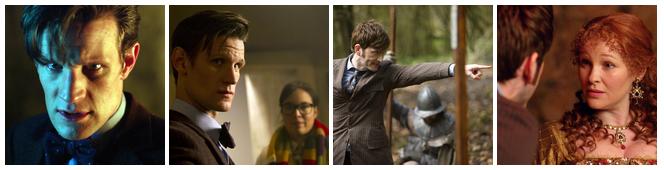
 The BBC have released
  Cineworld Shaftesbury Avenue are offering readers of Doctor Who News two tickets to the screening of

 The twenty-eighth episode in our series telling the story of the creation of Doctor Who, from conception to broadcast.
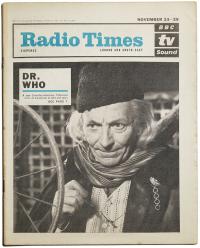
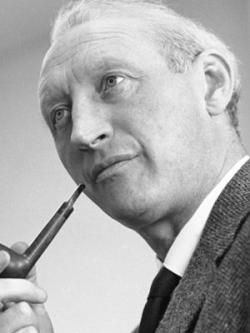 One of the best ways for the BBC to promote its programmes in the 1960s was through its own weekly listings magazine, the Radio Times. The magazine was almost as old as the BBC itself, having been launched in 1923, just one year after the BBC began transmissions. In 1963 it turned forty, and was already something of a national institution. Until the deregulation of the TV and radio listings industry in the early 1990s, it was the only place where readers could find detailed information about all of the BBC's programmes for the full week ahead. It was therefore one of the UK's best-selling magazines, most of the population had at least a passing familiarity with it, and it was both a valuable source of revenue for the corporation (unlike on television or radio, the BBC could sell advertising in the pages of the Radio Times) and a tremendous source of publicity, of immense value in promoting programmes.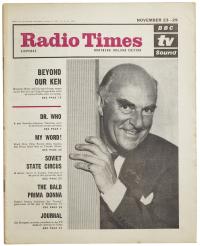




 Subscribe to News
 Follow us on Twitter
 Like us on Facebook
 Contact Us