Denmark showing for Day of the Doctor

Friday, 1 November 2013 - Reported by Marcus
The Day of the Doctor - Promotional Poster (square) (Credit: BBC/Adrian Rogers)Fans in Denmark will be able to see the 50th Anniversary special, The Day of the Doctor, at one of three special showings at the CinemaxX cinema chain.

The episode will be shown on the evening of 23rd November at branches in Odense, Aarhus and the capital Copenhagen.

The showings were announced yesterday following mail and internet campaigns from fans in the country. National Danish TV channel DR3 has just completed screenings of seasons 5 to 7 of the new series.
Thanks to Steen Schapiro


FILTER: - Day of the Doctor - Denmark

BFI: Eighth Doctor panel video

Thursday, 31 October 2013 - Reported by John Bowman
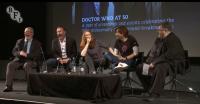
A video of the main guest panel for the BFI's Eighth Doctor celebratory event was uploaded for viewing this morning.

Held on Saturday 5th October as part of the organisation's Doctor Who At 50 season, it saw Paul McGann, Daphne Ashbrook, and Geoffrey Sax in discussion with season co-curator Justin Johnson, following a big-screen showing of McGann's sole TV outing as the Doctor (up to now).


Earlier, Andrew Cartmel, Nicholas Briggs, Gary Russell, and Jason Haigh-Ellery formed a panel to talk about the years between the McGann movie of 1996 and the show's return in 2005.


FILTER: - Special Events - UK - Online - Eighth Doctor - BFI - WHO50 - Paul McGann

Hadoke adds dates to Stepson tour

Thursday, 31 October 2013 - Reported by John Bowman
Comedian Toby Hadoke has added a number of dates to his tour of My Stepson Stole My Sonic Screwdriver.

The actor and writer, who is a moderator on classic Doctor Who DVD releases and is a contributor to Doctor Who Magazine, will be performing the show as follows:
My Stepson Stole My Sonic Screwdriver

Join Toby as he takes you on a heart-warming journey that begins with losing a partner, ends with gaining a stepson, and pays homage to the restorative powers of the Time Lord in between. Intimate knowledge of the TARDIS is not required to enjoy this bitter-sweet comedy of parenting through sci-fi evangelism.
Stepson is a follow-up to Hadoke's acclaimed one-man show Moths Ate My Doctor Who Scarf.


FILTER: - UK - Theatre - Comedy

The Eleventh Doctor Revisited on BBC America

Monday, 28 October 2013 - Reported by John Bowman
BBC America will be finishing its celebratory series Doctor Who: The Doctors Revisited on Sunday 24th November - the day after the show's 50th anniversary - when it marks the Eleventh Doctor's era.

A special documentary entitled Doctor Who: The Doctors Revisited - The Eleventh Doctor will air at 8pm ET/PT, in which Matt Smith, Jenna Coleman, and Steven Moffat will be among the participants examining the human side of this Doctor and taking a look at how all the years he has lived have affected him.

As previously reported, the documentary will be followed by the Series 6 opening two-parter The Impossible Astronaut and Day of the Moon. Written by Moffat, directed by Toby Haynes, and originally broadcast in April 2011, these episodes were - appropriately enough - the first ones to see Doctor Who's lead actors filming in the USA for a story.
A strange summons reunites the Doctor, Amy, Rory, and River, and they are soon plunged into an adventure where the team must fight an alien invasion dating back to the beginnings of human civilisation.


FILTER: - Steven Moffat - USA - BBC America - Matt Smith - Jenna Coleman - Eleventh Doctor

BFI: Tenth Doctor panel video

Monday, 28 October 2013 - Reported by John Bowman
The video of the guest panel at the BFI's celebratory screenings for the Tenth Doctor's era is now available to watch online.

Held on Sunday 29th September as part of its Doctor Who At 50 season, the event saw The Stolen Earth and Journey's End shown on the big screen, with David Tennant, Catherine Tate, Phil Collinson, and Graeme Harper taking to the stage afterwards for a discussion and question-and-answer session with season co-curator Justin Johnson.

A three-minute excerpt was uploaded to the BFI's YouTube channel today,
with the full Q&A - just shy of 30 minutes in length - available to watch in the BFI's video section.


FILTER: - Special Events - UK - Online - Catherine Tate - David Tennant - BFI - WHO50

An Unearthly Series - The Origins of a TV Legend

Sunday, 27 October 2013 - Reported by Anthony Weight
The Dalek Factor
Part twenty-seven in our series telling the story of the creation of Doctor Who, and the people who made it happen.

After the travails of recent weeks, with the abandonment of the original pilot and the cold feet of the Controller of BBC1, as October began to draw to a close Doctor Who was looking a little safer. It was guaranteed a run of at least 13 episodes, and the second of those had now been recorded, with rehearsals due to begin on the third. Work was also continuing on pre-production and scripting for other serials, most immediately the seven-episode adventure by writer Terry Nation, which was to come second in the running order.
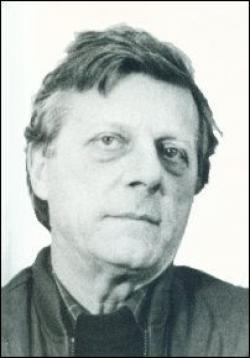
This would include creatures called the Daleks - Doctor Who's first race of alien monsters. On Sunday 27th October 1963, exactly fifty years ago today, draughtsman A. Webb drew up the earliest surviving formal designs for the Daleks, from the plans of designer Raymond Cusick. These would be sent to Shawcraft Models, to be constructed ready for use by 20th November. Nobody at the time knew it, but a legend was being born.

Nation's serial was to be an important one for the young series. Neither producer Verity Lambert nor story editor David Whitaker had been entirely keen on the opening story, An Unearthly Child by Anthony Coburn, but by the time they both joined the series it was too late to change it. Nation's scripts would therefore be the first serial they had entirely sought out and commissioned themselves, with Whitaker having selected Nation after being impressed by his work on the ITV science-fiction anthology series Out of this World. Nation had initially been unwilling to work on the programme, but after parting with his previous employer, comedian Tony Hancock, had taken up the offer. Nation had been able to deliver his scripts quickly and write efficiently within the format of the programme, and Lambert and Whitaker had been impressed with his work. With no other serial in as ready a state as Nation's, his tale of post-apocalyptic struggle on a distant alien world was promoted to second in the young programme's running order.

At seven episodes, Nation's scripts would take up a sizeable chunk of the 13-episode run that Doctor Who had been given in which to prove itself by a somewhat reluctant BBC1. The Head of Serials, Donald Wilson, disliked Nation's scripts and did not want Lambert to use them, but she successfully argued that nothing else was ready. Wilson's superior, the Head of Drama Sydney Newman, did not see the scripts or any designs for the serial, as by this stage he was taking a less hands-on role in the production of the programme that he himself has initiated - he did not see the Daleks until the viewers themselves did, in December.

Cusick had not been the designer originally allocated to the story. Future Hollywood film director Ridley Scott, then also working for the design department of the BBC, had orignally been given the task, but problems with his availability meant that it was Cusick who had to come up with a design to match the description in Nation's script:

Hideous machine-like creatures. They are legless, moving on a round base. They have no human features. A lens on a flexible shaft acts as an eye. Arms with mechanical grips for hands. The creatures hold strange weapons in their hands.

Nation was keen to get away from traditional science-fiction film images of monsters being obviously men dressed up in suits, but when Cusick sought advice on how to realise this concept from Doctor Who's veteran associate producer Mervyn Pinfield, he was dismayed to hear Pinfield suggest just that. Pinfield had been assigned to Doctor Who particularly for his ability to advise on technical matters, and his suggestion for the Daleks was a budget-conscious one. He told Cusick to design a costume of a large cardboard tube around the actor's torso, with other tubes around the arms and legs, and for the whole ensemble to be painted silver.

Cusick found greater inspiration when he spoke directly to Nation. The scriptwriter had been enthused by seeing a performance by the Georgian State Dancers, in which the female members of the Soviet group wore long dresses entirely concealing their legs and feet, and thus seemed to glide across the floor without any visible method of movement. Cusick, inspired by this, experimented with various designs all based around the idea of a seated operator entirely enclosed by the outline of the design, with no visible arms or legs.
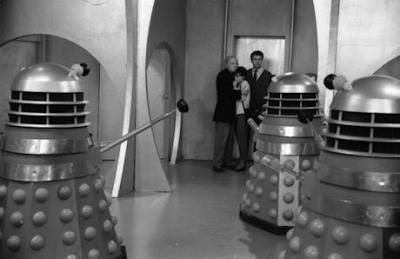
Cusick worked throughout October on refining the design, consulting with other experts in the field such as Bernard Wilkie and Jack Kine of the BBC Visual Effects Department. By 27th October, fifty years ago today, he had completed his design, to be constructed by the outside company Shawcraft Models. This was still not quite the final design - after the designs had been delivered to Shawcraft, the company's boss Bill Roberts made his own refinements to make the props easier, cheaper, and more efficient to construct within the time and budget available. Changes Roberts made included having the gun and sucker arms mounted on the same level, rather than at different levels as in Cusick's design. But beyond such comparatively minor changes, the design of the Dalek, the iconic image familiar to millions even fifty years later, all stems from the designs of October 27th.

Shawcraft would have £750 to construct the four Dalek props which would be needed for the making of Nation's serial, but the appearance of the creatures was not the only element that was being developed through October. The Dalek serial had been assigned two directors - the more experienced Christopher Barry would handle the majority of the serial, while newcomer Richard Martin would also direct some episodes, to help learn his trade. Barry had initially approached the Post Office's Joint Speech Research Unit to investigate providing voices for the Dalek creatures, but wasn't quite able to obtain what was wanted. Martin then approached a body which had already worked on Doctor Who, providing the theme tune - the BBC's own Radiophonic Workshop, based at Maida Vale.

The workshop's Brian Hodgson met with Martin, who explained the type of grating, metallic voice that was wanted. Hodgson, inspired by a robot voice he had previously created for a radio serial called Sword From the Stars, came up with the idea of using a ring modulator to process an actor's voice and create the kind of effect that was desired. Hodgson and Martin experimented with using the modulation process on the voice of actor Peter Hawkins, concentrating on the vowel sounds where the modulation was most effective. The trial session took place in Studio G at Lime Grove Studios on 24th October 1963, when Cusick's designs for the creatures they were coming up with a voice for had still not been completed. The two elements would come together to create a sensation - although nobody, of course, knew that at the time.

Doctor Who had still to prove itself - but with less than a month to go until the transmission of its first episode, there was not long to wait to see what the general public would make of this programme that had been enduring such a struggle to reach the screen. Meanwhile, production continued both on the first serial and on the Dalek adventure - from Monday 28th October, Waris Hussein and his cast would begin rehearsing the third episode of the programme, The Forest of Fear, while on the same day at the BBC Television Film Studios at Ealing pre-filming work began on The Daleks, using 35mm film for stunts, model work and other complicated sequences.

Next EpisodeAn Absolute Knock-Out
SOURCES: Doctor Who Magazine issue 331 (Panini Comics, 25 June 2003); Doctor Who Magazine issue 460 (Panini Comics, June 2013); Dalek 6388 - 1: The Dead Planet
Compiled by:
Paul Hayes


FILTER: - The Story of Doctor Who

Cinema screenings of The Day of the Doctor announced for the US

Thursday, 24 October 2013 - Reported by Harry Ward
The Day Of The Doctor; US Screening poster (Credit: BBC) BBC America have announced that 3D cinema screenings of The Day of the Doctor will take place across the United States on 23 and 25 November.

Participating cinemas on 23 November are listed below. Tickets for these screenings will go on sale tomorrow (25 October) at 9am EST and may be purchased from Cinemark.com and Fandango.com.
Los Angeles: Cinemark Rave 18 + IMAX (Los Angeles, CA), Century Huntington Beach and XD (Huntington Beach, CA)
New York: AMC Loews Village 7 (New York, NY), Regal E-Walk Stadium 13 & RPX (New York, NY)
Chicago: Century 12 Evanston/CinéArts 6 and XD (Evanston, IL), Cinemark 16 + IMAX (Woodridge, IL)
Philadelphia: University Penn 6 (Philadelphia, PA), Cinemark 16 (Somerdale, NJ)
Dallas-Ft. Worth: Cinemark West Plano + XD (Plano, TX)
San Francisco-Oak-San Jose: Century San Francisco Centre 9 (San Francisco, CA)
Washington, DC (Hagerstown): Fairfax Corner 14 + Xtreme (Fairfax, VA)
Houston: Cinemark 17 + XD (The Woodlands, TX)
Atlanta: Cinemark Tinseltown 17 (Fayetteville, GA)
Seattle-Tacoma: Lincoln Square Cinema 16 with IMAX (Bellevue, WA)
Minneapolis: AMC Southdale 16 (Edina, MN)
You can find a full list of participating cinemas showing the episode on 25 November at the Fathom Events website.

Soumya Sriraman, EVP Home Entertainment and Licensing for BBC Worldwide North America, commented:
Doctor Who’s 50th Anniversary is truly a global celebration and we’re thrilled to bring the special to the silver screen. Our partnerships with Cinemark, AMC, Regal Cinemas and NCM Fathom Events will give fans, on November 23 and 25, the opportunity to see the Doctor in a whole new way – in RealD™ 3D.
Shelly Maxwell, executive vice president of NCM Fathom Events said:
The Day of The Doctor is upon us and fans of the BBC AMERICA sci-fi series Doctor Who have the opportunity to see the time-travelling adventures like never before in 3D from their local movie theater. There’s never been a better time to be a Whovian during the 50th Anniversary celebration of this huge BBC hit that’s invaded America.


FILTER: - USA - Day of the Doctor - WHO50

BFI: Day of the Doctor and Eleventh Doctor screenings

Wednesday, 23 October 2013 - Reported by John Bowman
With exactly a month to go now to Doctor Who's 50th anniversary, the BFI today announced the final screenings in its year-long celebration of the programme.

It will be showing the anniversary episode The Day of the Doctor in 3D on Saturday 23rd November as part of the global simulcast and cinema screenings worldwide. The time is yet to be confirmed by the BBC. Tickets will go on sale to BFI members from Friday 25th October (9am online and 11.30am by phone and in person) and to non-members from Saturday 26th October from 11.30am. They can be bought via this link. (It should be noted that the start time of 7pm given by the BFI is for guidance only. According to the BFI, the exact start time will be given 10 days before the screening.)

Justin Johnson, the programmer of the BFI's Doctor Who At 50 strand, said:
The BFI is very proud of our long relationship with both the BBC and the Doctor Who production team, and we are delighted to be able to mark the 50th anniversary, and the culmination of our year-long celebrations, with this special screening of The Day of the Doctor.
Then, just over a fortnight later, on Sunday 8th December at 3.45pm, it will mark the Eleventh Doctor's era by showing The Eleventh Hour and The Name of the Doctor. The guest panel for that event is yet to be announced.

Johnson, who curated the season with Dick Fiddy, commented on its culmination by telling Doctor Who News:
It's hard to believe that we're now only a month away from the official 50th anniversary and our year-long celebrations here at BFI Southbank are finally drawing to a close. With ten Doctors under our belt, there's only room for one more, and with An Adventure in Space and Time and The Day of the Doctor 3D both playing in NFT1 in November, our final time-travelling voyage is set for Sunday 8th December as we look at the most recent incumbent to grace the TARDIS.

It's been an amazing year, and if Dick and I had to turn the clock back a year and ask ourselves who we hoped would have graced our stage, we could never have predicted that we would have been in such illustrious company.
Tickets to the Eleventh Doctor screenings on 8th December will be allocated by ballot via the members' section, which BFI Champions can enter from Monday 4th November, and Cinema Members from Tuesday 5th November. The ballot will close on Friday 8th November and will be run over the weekend of 9th and 10th November, with all entrants being notified on Monday 11th November as to whether or not they have been successful. All tickets reserved for Champions and Cinema Members via the ballot will be held for claiming by them until 8.30pm on Friday 15th November, and any that are unclaimed by then will be released for public sale on Saturday 16th November.

As has been the case with all previous events in the season, it will undoubtedly sell out to Champions and Cinema Members, but returns and stand-bys will be a strong possibility, so keep checking with the BFI.

UPDATE - 26th OCTOBER: The BFI was forced to suspend ticket sales for The Day of the Doctor yesterday because of "an issue with card payments". Sales reopened for members today at 9am (online) and 11.30am (phone), and will reopen tomorrow to non-members.


FILTER: - Special Events - UK - BFI - Eleventh Doctor - WHO50

The Day of the Doctor: UK cinema screening locations announced

Tuesday, 22 October 2013 - Reported by Chuck Foster
The Day of the Doctor - Promotional Poster (landscape) (Credit: BBC/Adrian Rogers)BBC Worldwide have announced venues for the 3D screenings of the 50th Anniversary adventure The Day of the Doctor, which will be simulcast in cinemas around the world on the Saturday 23rd November.

In the UK, some 216 VUE, Cineworld, Odeon, BFI and Picturehouse cinemas will participate, with tickets going on sale from this Friday, 25th October at 9:00am.

Internationally, Germany, Russia, the USA and Canada will also have simultaneous screenings with BBC One in the UK, with some 106 cinemas in Australia and New Zealand participating later in the day, as previously announced. Further countries are expected to be announced shortly.

Full details of the announced countries and cinema chains, plus specific booking details can be found via BBC Worldwide.

Find a Cinema Venue for The Day of the Doctor (Credit: BBC Worldwide)

Meanwhile, BBC America will announce details regarding the 3D screenings in select cinemas in the US and Canada.

Note: not all cinemas will simulcast the episode, please check the relevant cinema time for confirmation.


FILTER: - Special Events - UK - Day of the Doctor

An Unearthly Series - The Origins of a TV Legend

Tuesday, 22 October 2013 - Reported by Anthony Weight
A Crisis Out of a Drama
The twenty-sixth episode in our series telling the story of the creation of Doctor Who and the people who made it happen, fifty years to the day after the major events.

Doctor Who had finally entered regular production, with the new version of the opening episode having been completed, and a new episode being rehearsed. But the Controller of Programmes for BBC1, Donald Baverstock, worried by the financial demands of the series and particularly of the TARDIS interior set, had ordered that production be halted after the opening four-part serial. With Baverstock now on leave, Doctor Who's creators and production team rallied to reverse his decision and prevent the programme from being killed-off before transmission had even begun.

Before Baverstock had departed on three weeks' leave, in his memo to Donald Wilson asking that Doctor Who be stopped after four episodes, he added that he had asked Joanna Spicer and John Mair, from the planning staff, to look into the costs of the series and whether there might be any possibility of continuing. Mair subsequently sent Spicer a memo outlining the story of Doctor Who's production so far, and the costs that had been incurred and might be further incurred in the future. On Tuesday 22 October 1963, exactly fifty years ago today, Spicer held a meeting with some of the key figures involved in Doctor Who and from various BBC production departments, to discuss whether the series could be saved.

Among those present at the meeting along with Spicer were Mair, Wilson (the Head of Serials in the drama department, and thus directly responsible for Doctor Who), the show's producer Verity Lambert, James Bould (the Design Manager for BBC Television) and Jack Kine (the co-founder of the BBC Visual Effects Department). Between them, they were able to thrash out a plan whereby Doctor Who could be allowed to continue - at least for a time. Spicer indicated that Baverstock would be prepared to accept an initial 13-episode run of Doctor Who - returning to a decision he had previously made a week earlier, before his sudden cold feet about the show before going on leave. However, this would only happen if the series could be made within strict limitations on budget and man-hours, with per-episode budgets strictly limited at £2500 each. £75 per episode will go towards the cost of "the ship," £200 on using an outside firm to provide scenic effects, and £500 per episode as the design department's budget. The man-hours allocation is to be 500 per episode.

While more meetings would be needed to work out the exact details, Wilson and Lambert agreed that Doctor Who could produce a 13-episode run within these limitations. Given that the opening serial was due to be followed by Terry Nation's seven-part serial featuring his Dalek creatures, later in the week Lambert and her story editor David Whitaker realised that they would need to add a two-part story after Nation's tale, to create the initial 13-episode run that had been agreed to. With the limited time available, and the fact that there will be no money for additional sets or guest characters, it is decided that Whitaker himself will write a two-part adventure featuring only the four regular cast members, and set entirely on the expensive TARDIS interior set.

During the week, Whitaker also began to establish what stories would follow if Doctor Who were allowed to continue beyond the 13 episodes tentatively agreed to. Being worked on are: a historical story by John Lucarotti in which the time travellers meet Marco Polo; the latest version of the much-desired "miniscules" storyline, now being worked on by Robert Gould; The Masters of Luxor by Anthony Coburn; a possible seven-part historical tale by Whitaker; The Hidden Planet by Malcolm Hulke; The Red Fort, set during the Indian Mutiny, by Nation; and another future-set story, to be four episodes long, with a writer yet to be assigned. This would bring Doctor Who up to the 52-week run originally envisaged by Head of Drama Sydney Newman, should the programme eventually be allowed to continue that far.

By this point, no directors had been assigned to any serials beyond Nation's, on which it has been decided that Christopher Barry will share duties with the less-experienced Richard Martin, a young director who has been attached to Doctor Who for some time. Martin has become very interested in the series, and around this time sends Barry, Whitaker, Lambert and associate producer Mervyn Pinfield a lengthy and detailed memo outlining his thoughts about the TARDIS and its effect on those who travel in it, which reads in part:

The ship is out of time, but in space. The entrance is in both time and space. The entrance (the phone box) can be be described as a time/space ship gangplank. Or compression-decompression (comparison-decomparison) chamber.

The only way to pass down the gangplank is by an effort of will. Therefore if you are afraid or doubtful all you would find is the interior of a phone box, and if you stayed inside you would have a bad headache from the intercellular electronic pulses forming the mental link. Therefore it is not easy to get in and out of the ship. For those unused to it traumatic.

Meanwhile, away from meetings and memos and debates over the future, Doctor Who's regular production is now under way. Having completed the first episode, director Waris Hussein and the cast have moved onto rehearsing "The Cave of Skulls", the second instalment of the opening serial. This was then recorded on Friday 25 October, a week after the previous episode, with Doctor Who to be recorded every Friday until at least 13 episodes have been completed. What would happen after that would depend on whether the costs could be kept down, and how those 13 episodes were received.

The immediate crisis surrounding the future of Doctor Who was over, and it would at least have a chance to make it to the screen. What impact it would have with the audience remained to be seen - but, unknown to anybody, already on the drawing board and nearing completion was a design that would help to take Doctor Who from troubled children's serial to national institution.

Next EpisodeThe Dalek Factor
SOURCES: The Handbook: The First Doctor – The William Hartnell Years: 1963-1966, David J Howe, Mark Stammers, Stephen James Walker (Doctor Who Books, 1994)
Compiled by:
Paul Hayes


FILTER: - The Story of Doctor Who